Technology
Leading games research in the AI era
UC Presidential Chair Magy Seif El-Nasr shares insights on how AI has shaped academic publishing, and her observations on an emerging “AI divide.”
Laura Sofia Martinez Agudelo https://betterimagesofai.org / https://creativecommons.org/licenses/by/4.0/
Press Contact
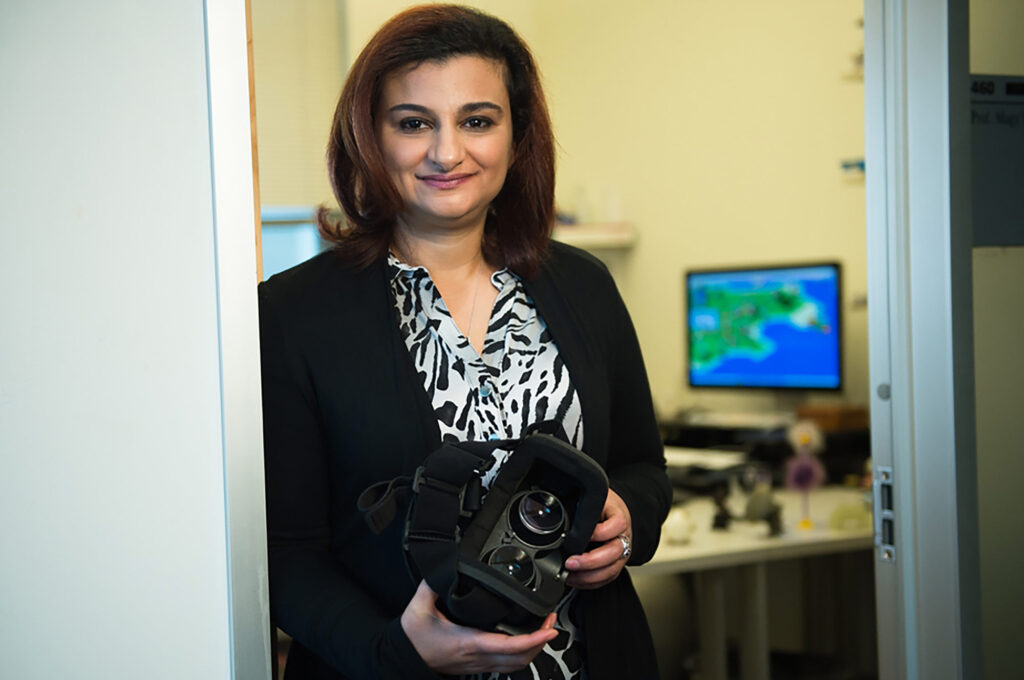
Magy Seif El-Nasr is a professor of computational media at the University of California, Santa Cruz, and a longtime leading researcher in the fields of games, AI, and Human Computer Interaction. As the UC Presidential Chair for the campus, she is leading several initiatives on AI and education.
She recently took the role of Editor-in-Chief of IEEE Transactions on Games, a reflection of her leadership in the field and the strength of computational media at the Baskin School of Engineering at UC Santa Cruz. Established in 2009, the journal is the first-ever academic journal in the field and one of the major publications in games today. Here, she discusses changes to the field in an era in which AI is transforming education, research, and productivity.
Describe the core focus of IEEE Transactions on Games. How do its themes align with the research conducted in your lab, and in the Baskin Engineering Computational Media department?
The scope of the journal is pretty broad; it focuses on the technical research in games, which includes the scientific, technical, and engineering aspects of both digital and traditional games. This also closely aligns with the work my lab has always done. When the journal first started [as IEEE Transactions on Computational Intelligence and AI in Games], it focused heavily on AI and procedural content generation. Under [former EiC] Graham Kendall, the journal rebranded and the name was changed to Transactions on Games. Kendall also broadened the scope to encompass a much wider, multi-disciplinary array of technical games research. Former EICs, Julian Togelius and Georgios Yannakakis worked hard to expand the journal’s reach and establish it as the premier archival venue for technical, scientific, and engineering-focused game research. In 2023, ACM Games: Research and Practice was established as a journal, taking a social and humanities direction. Our community within games is small but strong and growing!
Why were you interested in taking on the role of Editor in Chief?
I’ve recently finished my term as chair of the computational media department, and I had to decide what was next. I realized I’m more interested in building the research community than in continuing with internal academic administration—I want to be externally focused. I was approached by the former Editor-in-Chief, and he suggested that I would be a great fit to this position because I could help connect the journal to communities they are not currently reaching.
At a recent seminar on the future of games for social impact, we had a wonderful discussion about the field’s growth. When I started, there was virtually no formalized ‘field’ of games! There were no dedicated conferences, journals, or funding in the area—but slowly the field started to grow. Now, we have funding and dozens of conferences on games across industry and academia. But with all these platforms, we still haven’t done more to make a bigger social impact with games, and there’s still a lot of issues. We brainstormed a lot of different directions, like publishing data so research is more reproducible, writing more systems-level software engineering papers, publishing negative results for students and new researchers to learn from, or research partnerships with industry to reach bigger audiences. I thought the journal would be a great way to think about how we could enable these directions.
I recently started as the director of the UC Santa Cruz Center for Computational Experience. My vision is to broaden the center to connect the different disciplines within the university that want to experiment with the use of computational media—simulation games, embodied AI, all forms of experiences—to make social impact and advancements in different fields, including psychology, social sciences, and humanities. I think these two roles will go in parallel.
What new themes are you seeing emerge in research on games?
A significant amount of work on AI! What’s interesting is that everyone is working on similar problems. The publication rate is rising rapidly; people now frequently release non-peer-reviewed preprints on arXiv. We can hardly read through the sheer volume of papers, so how can we as a community keep up to date with everything without having that social network? What I’m seeing is a lot of papers that look like each other, because people are working in similar areas. Many are going after the low-hanging fruit, rather than tackling the larger, foundational problems. There’s a lot of work that still needs to be done on the design, evaluation, and policymaking given the work on automation, and human-centered or human-in-the-loop automation and computational media—which is important.
In what ways are you pushing the journal to expand and evolve?
Even with such a broad scope, I still feel that submissions are primarily coming from the same core group of researchers who already know the journal. I’m working on building up our social media presence and our capacity to attend different conferences and reach different communities. I created different roles for associate editors—senior associate editors, who are advisors helping us evolve the journal; industry associate editors, who help engage industry participation; and expanded the different areas represented by associate editors to include graphics, software engineering, modeling, analytics, and design, to name a few.
My focus right now is on securing more industry partnerships and expanding into different communities. We have started a partnership with the graphics conference i3D, and have an existing long term relationship with the IEEE conference Conference on Games. We are trying to establish relationships with other conferences, too.
Submissions to journals like ours have started to increase rapidly due to several reasons, including increasing capacity for research overseas, especially in China and other areas of Asia, plus the added acceleration in writing due to AI. When Georgios stepped down, he warned me that I would be getting around five papers a week. Now, we’re getting five papers a day! And that’s an increase we’ve been seeing all across engineering because of AI.
What are some bigger issues you would want researchers to tackle?
How can we enable human flourishing, or human empowerment, with AI? That could be in the health field, the games field, many fields—but it’s something that’s still growing, and I’m not sure we have a theoretical trajectory of how we can address it.
There’s a lot of fear surrounding AI, but if you’ve used AI quite a bit, then you know that there are a lot of issues with the current models. There’s a lot of work that tries to explain AI’s answers, which helps you trust the AI’s answer more—or not trust it, if the reasoning is not great. But we need more guardrails, and to look at what the causes are from the model and implementation side that cause these misinterpretations and hallucinations, so people can correct and make progress on the models. That’s an interesting topic that I think is important for people to work on, especially now. My Ph.D. student Reza Habibi is working in this area.
There are many social and ethical issues with the use of AI, especially for game content development and game design. We haven’t yet figured out a way to evaluate that use. We have a long road to take towards examining how to design better human-AI systems and how to use AI responsibly. That’s an interesting and important area.
You’ve discussed the idea of an AI divide. How do you define that, and how do you see it affecting students, researchers, and others?
Just like the digital divide, people who have access to AI are the ones who are going to be able to leverage it. When they enter college, they have already used it in some form, and that enables them to do different things that other people would not do. That access issue is one of the things I’m seeing.
Another issue is that some of my students offload tasks to AI and take whatever it tells them as authoritative. They don’t question it or do anything else with it. Other students are much better at using AI as a partner, correcting some of the things it’s saying, and adjusting until they get something they like. Why do some people have this mentality and others don’t? I don’t know if it is an AI literacy issue, a metacognition issue, or a habit learned from previous educational experiences. I do not believe research has fully answered this yet. I think this is another kind of divide, on the cognitive level.
I think games can push further towards AI literacy—teaching students to use AI effectively, which is important in today’s industry, but also to think responsibly about the next generation of AI design and use. I think games and computational media can be used to simulate that direction of work.
AI, in different iterations, has long been part of the field of games. How is this rapidly changing technology affecting games in 2026, and what do you expect to see in the coming months or years?
Yes, AI has been around since the 1950s, officially beginning as an academic discipline in 1956 at the Dartmouth Summer Research Project. It has been through several ‘summers’ and ‘winters’. The previous dominant direction was highly symbolic, but when that approach reached its limits, AI entered a winter. Now, we are relying heavily on neural-based systems and increasingly integrating neurosymbolic methods, because there is a sense that the field may face another winter as neural architectures reach their own limits. The question is when will it get there, and how do we extend it? It’s interesting, and it’s affecting all fields, including games.
Games have seen a lot of AI content development, and an increased use of AI for behavior modeling, monetization, and design. The issues are: if you use AI for generation, then you’re getting a lot of content that’s similar to each other, so what differentiates one game from another? How is something going to become a multi-million-dollar game compared to its competitors? Creativity has to be embedded somewhere, and the field is still adapting to the big boom in new AI frameworks that can do a lot that we couldn’t do before. That’s affected both industry and academia.
In the industry, many artists and designers are upset that their job might be taken away by AI. But I do think that it’s obvious now that things generated by AI are going to become stagnant and too similar to each other, so artists and designers are always going to be important.
For academia, the new models were also a shock, especially to game AI researchers, because the models are doing things that we thought would never be done by AI. Now that people are starting to test and realize its limits, they’re building research on top of it. There was a period of a year or two where the sentiment was, ‘Is this solving all our research problems? Is this solving our entire field?’ But I think people have now adapted, and new areas of research are starting to open up.