Climate & Sustainability
Altering the atmosphere could fight climate change, but is it worth the risk? Who gets to decide?
As solar geoengineering technology becomes increasingly viable, public participation in its governance will be essential. A new book shares strategies for supporting public voice.

The Sun illuminates Earth's atmosphere, as seen from the International Space Station. Solar geoengineering is the concept of adding reflective particles to the atmosphere, where they could bounce some of the sun’s rays back into space, thereby limiting the amount of heat that reaches our planet. The technology comes with serious risks and has almost no governance guardrails at present. Photo: NASA
In case you hadn’t noticed, things haven’t exactly been going great lately when it comes to climate change. Global temperatures are currently on track to climb past 1.5 degrees celsius above pre-industrial levels within a decade. Breaching that warming threshold risks catastrophic damage to planetary systems that support ecosystems and human civilization.
To get things under control, we need to stop filling up our atmosphere with heat-trapping gasses produced by the burning of fossil fuels. There has been some important progress on that front, like the growth of solar power and continued global adoption of electric vehicles. But the pace of progress is currently too slow. And new challenges are emerging, like the energy-sucking data centers powering the boom in artificial intelligence.
Given those concerns, it can be tempting to look for a “quick fix.” And solar geoengineering certainly has that appeal. The concept is simple. If you spray reflective particles into the atmosphere, they could bounce some of the sun’s rays back into space, thereby limiting the amount of heat that reaches our planet. The technology is cheap and relatively easy to use. For that reason, some groups have already begun to apply it, vigilante style.
But there’s a catch. Large-scale solar geoengineering would discolor the sky and could disrupt rainfall patterns, among many other potential negative impacts. More importantly, many worry it might distract from the urgent need to reduce greenhouse gas emissions from fossil fuels. That would lead to continued harmful buildup of emissions, some of which would be absorbed by the ocean, increasing the acidity of seawater and threatening marine food webs. And if solar geoengineering efforts were to suddenly stop or fail, even faster catastrophic warming would result.
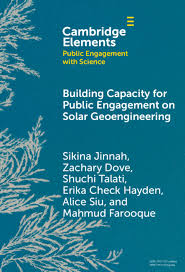
We’ve now reached an inflection point, in both the climate crisis and the development of solar geoengineering technology, where decisions are being made about whether or how these technologies will be deployed. Making those decisions ethically will require engaging the public. UC Santa Cruz Environmental Studies Professor Sikina Jinnah is working to help ensure that communities have an opportunity to make their voices heard.
Her latest book, an open access publication called Building Capacity for Public Engagement on Solar Geoengineering, presents a roadmap for how scientists and researchers, policymakers, practitioners, research funders, and others can prepare the public to take part in shared decision making. In particular, the book offers guidance for providing education on the science, policy, ethics, and justice issues related to solar geoengineering, so that communities can effectively weigh their options and consider what they stand to gain or lose.
Jinnah talked with the UC Santa Cruz news team about the current state of solar geoengineering governance and how she hopes her book could make a difference.
Solar geoengineering has been in the news quite a bit lately. Can you walk us through why we’re starting to see more discussion of it?
Solar geoengineering is a hot topic right now for a couple of reasons. One is that, increasingly, governments, NGOs, and publics are starting to realize that current climate mitigation and adaptation efforts — which are critically important — are currently wholly insufficient to address the scale of the climate crisis. And so, more and more people are thinking about solar geoengineering as a possible way to stabilize the climate for a short period of time. It’s not a long-term solution, and certainly an imperfect one, but it could buy us some time to scale up mitigation and adaptation.
But that comes with a lot of risk. One of those risks is that this approach that’s meant to be temporary becomes something that we get locked into. Governments and others could end up not putting the necessary time and attention into reducing emissions because they are focused on this so-called “technological fix” from solar geoengineering. So because of that and other risks, it’s extremely controversial.
What is your interest in solar geoengineering, as an expert in international environmental politics?

Well, I always like to clarify that I’m not advocating for these technologies. But this stuff is already coming down the pike. We have private sector actors that are already doing this work, and it’s largely ungoverned. Any large-scale deployment of a solar geoengineering technology, like stratospheric aerosol injection, would have a global impact. Who has control over how it’s used? There are serious equity issues and governance implications about who has access and who has that control. We need rules and structures in place and institutions to ensure that there’s collective decision making around these technologies.
We can’t bury our heads in the sand on this. There are a lot of frameworks out there that could help govern this technology in a way that would hedge against some of the most important risks. So we need to be engaging and advocating for how to govern what’s already happening, even if that is to say that we shut it down entirely. I’m not opposed to that outcome. But overall, the decision-making process needs to be based in science as well as public engagement and public knowledge about what the risks and benefits might be.
It sounds like it’s kind of the Wild West right now in terms of the lack of governance for these technologies. Is that a fair assessment?
Essentially, we have failed as a society to adequately set up governance mechanisms for solar geoengineering. It’s really hard to create predictability for researchers and private sector actors in a space that is just being governed in an ad hoc way. We need centralized mechanisms for everything from public input to transparency to funding pathways for these kinds of projects. These things are low-hanging fruit; it’s basically Governance 101 that we are, nonetheless, failing.
I think there are actually some cautionary lessons to be learned for other types of emerging technology from the governance failings in solar geoengineering. Without some of these governance basics of transparency and participation, what has happened in solar geoengineering is that those who think we shouldn’t be pursuing these technologies are now controlling the narrative. It has created an environment where even talking about solar geoengineering is considered almost like a betrayal. That’s really problematic, in my view. We need to be talking about it so that we can collectively make informed decisions about it.
What is at stake if the lack of governance guardrails for solar geoengineering continues?
Well, one example is a company called Stardust Solutions that has been developing a particle that they’re patenting for engaging in stratospheric aerosol injection, which is the primary, most controversial, and probably most researched solar geoengineering technology. And now they’re trying to lobby governments to be the contractor for deployment of solar geoengineering using their patented particle.
That is a huge problem. If you have particles being sprayed in the atmosphere that are protected by intellectual property, then we have no idea what they are. There’s no accountability mechanism. There’s no way to monitor impacts or predict impacts or ensure that we have public safety in the face of those kinds of particle releases. One of the core things we could do with governance is limit intellectual property around solar geoengineering. It’s just too risky for this technology to be in the private sphere in that way.
How do you hope your new book might help to solve these types of problems?
We essentially want to make engaging with these issues easier and more accessible for as many people as we possibly can. So our book is designed to support anyone who is interested in educating and engaging the public around these technologies and their governance. That could be an NGO, policymakers, high school teachers and college professors, or researchers who are engaged in outdoor experimentation for solar geoengineering and are trying to do responsible, community-engaged work around the sites of their deployments.
The first half of the book presents a variety of methods for engaging the public, and the second half provides educational materials. Our motivation was seeing how visceral a reaction people have to these technologies, coupled with a thirst for more knowledge about them. And most people don’t really have access to easily digestible materials for understanding solar geoengineering. We want to provide those materials, in order to expand the tent of who has access to information. We’re not trying to actually influence what people’s thinking should be. We want to enable them to make their own decisions about what the future of these technologies should be and help them participate in creating a pathway for that to happen.