Arts & Culture
Learning beyond the classroom: ten UC Santa Cruz students immerse themselves in Japanese art and culture
Ten students took part in an intense and immersive ten-day trip to Japan. Throughout the journey, they engaged in translanguaging, a practice that allows students to shuffle between two languages or more to deepen comprehension, express complex ideas, and build linguistic proficiency rather than treating languages as separate systems.
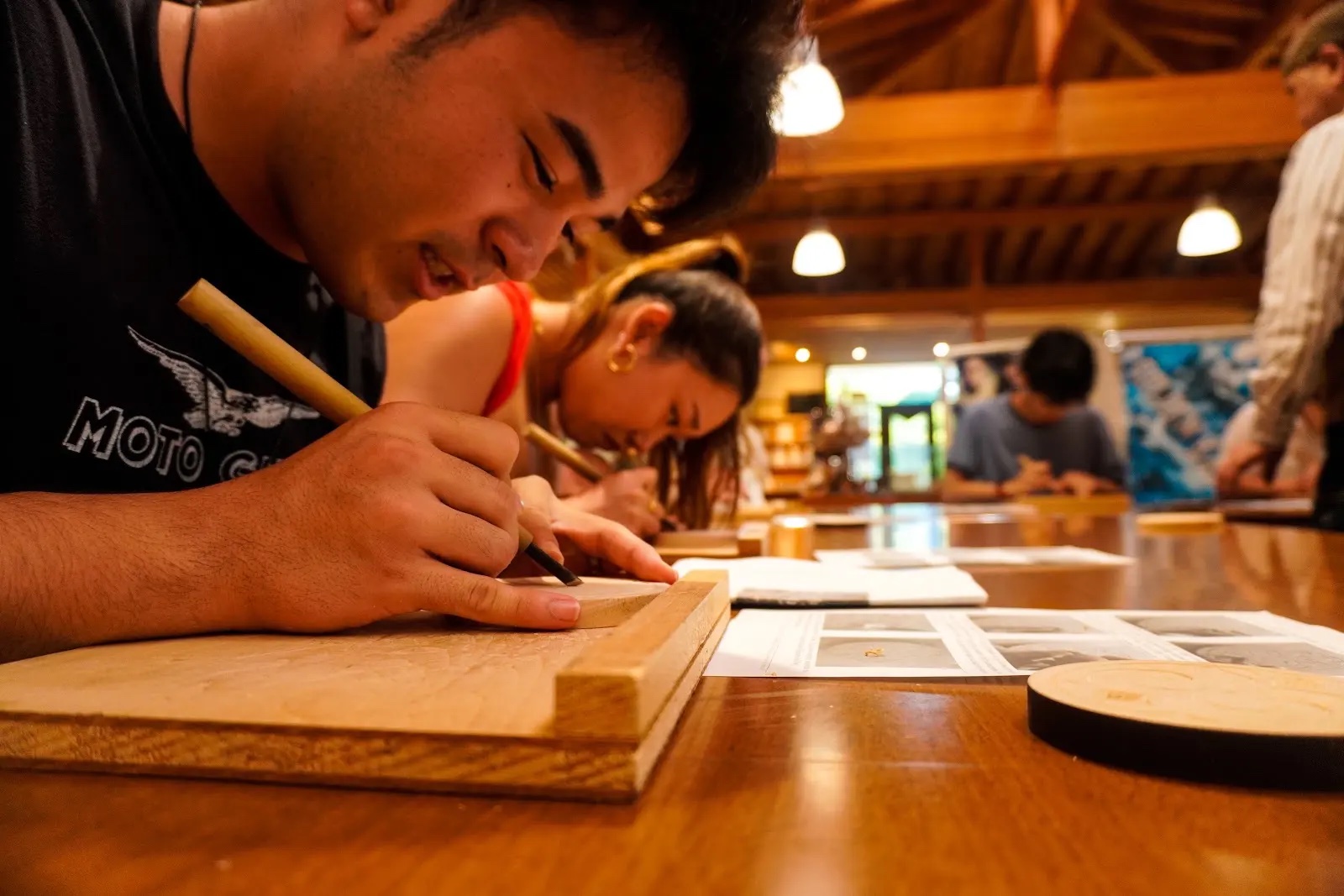
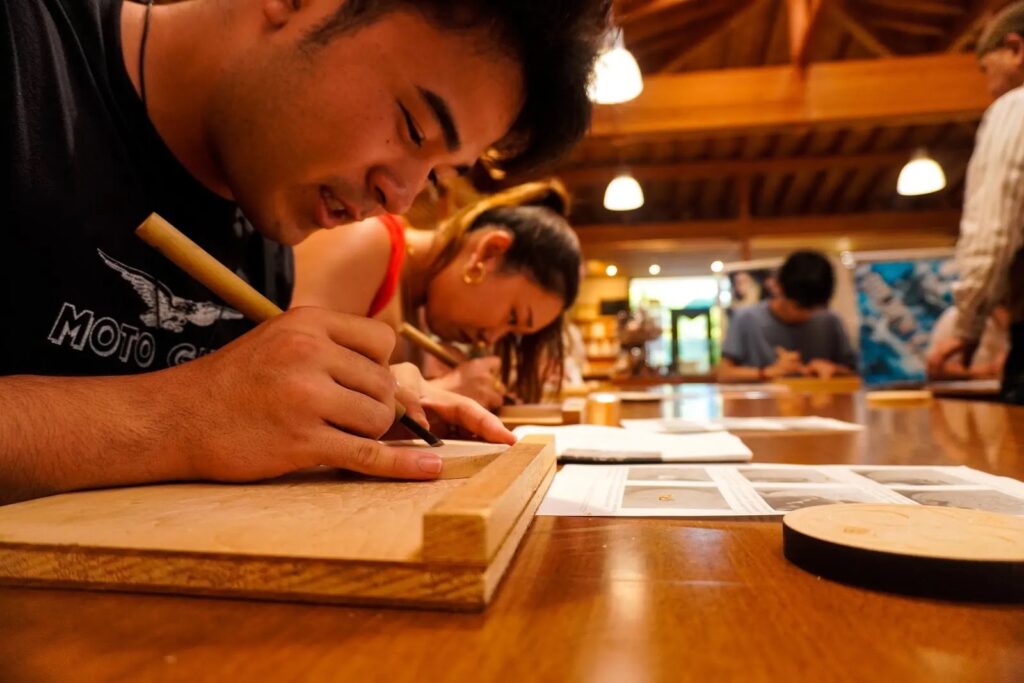
Learning Ainu wood carving: making a coaster with a chisel as part of immersive trip to Japan
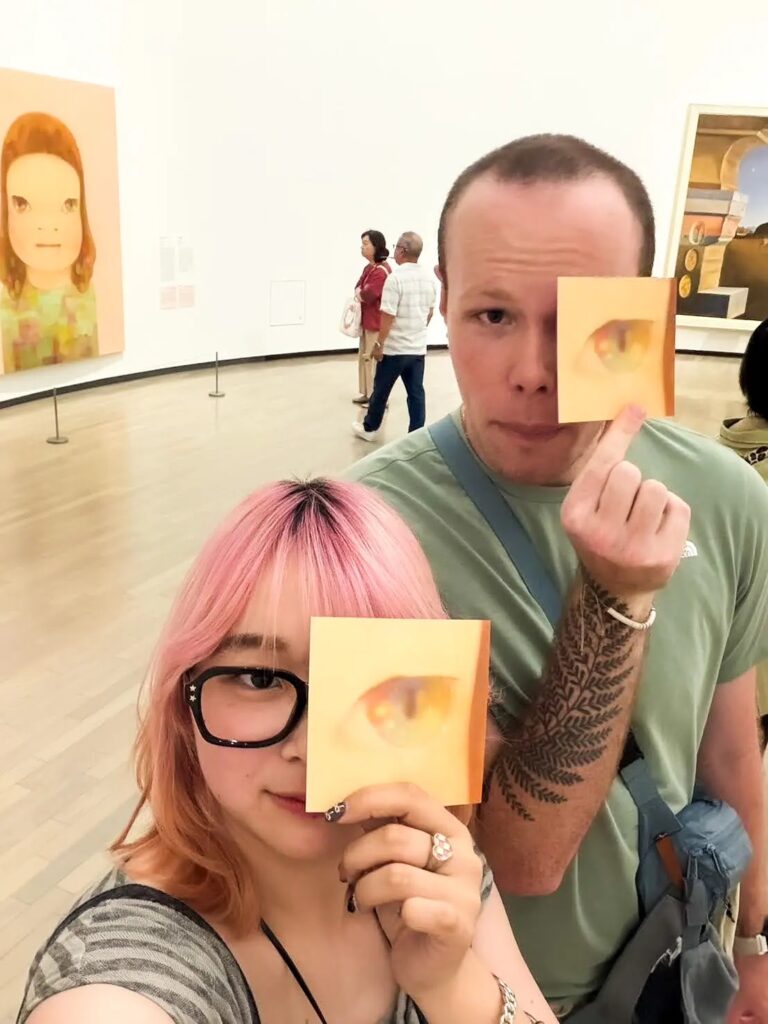
At the Yokohama Museum of Art in Tokyo, ten UC Santa Cruz students had a close encounter with Yoshitomo Nara’s Spring Girl/Miss Spring (2012), a painting of a wide-eyed young girl with a multicolored shirt and glowing teardrops.
The students had studied the picture in the course JAPN 111: Japanese Arts and Beyond, taught in spring 2026, but “Spring Girl/Miss Spring,” set against a bright pink background, was a much more intense experience when they saw it up close.
In person, the girl in the picture gazed back at the students.
“The painting was much bigger than I expected, and the impact was something I never knew I would experience,” said Misaki Kinoshita (Merrill ‘29, applied linguistics).
That close-up look at Spring Girl/Miss Spring was part of an intense, immersive ten-day trip to Japan, during which the ten students engaged in translanguaging, a practice that allows learners to move fluidly between two or more languages to deepen comprehension, express complex ideas, and build linguistic proficiency, rather than treating languages as separate systems.
Aside from seeing the paintings up close, they listened to artists explain the ideas behind their work.
Later in their travels, instead of studying the indigenous Ainu language of northern Japan in textbooks, they learned it straight from the people who still speak it in Hokkaido.
The trip—part of Japanese Arts and Beyond—took the students on a cultural tour that spanned the country. The Employing Humanities initiative created an international study immersion opportunity tied to new Humanities coursework, as part of the goal to expand experiential learning beyond internships and undergraduate research.
The Division funded students’ travel within UC policy to create an inclusive and equitable opportunity to participate in study immersion. In Tokyo, the itinerary included the Museum of Contemporary Art Tokyo, the Tokyo Photographic Museum, the Yokohama Museum of Art, and the Mori Art Museum. They also visited Tokyo University of the Arts to attend artist lectures.
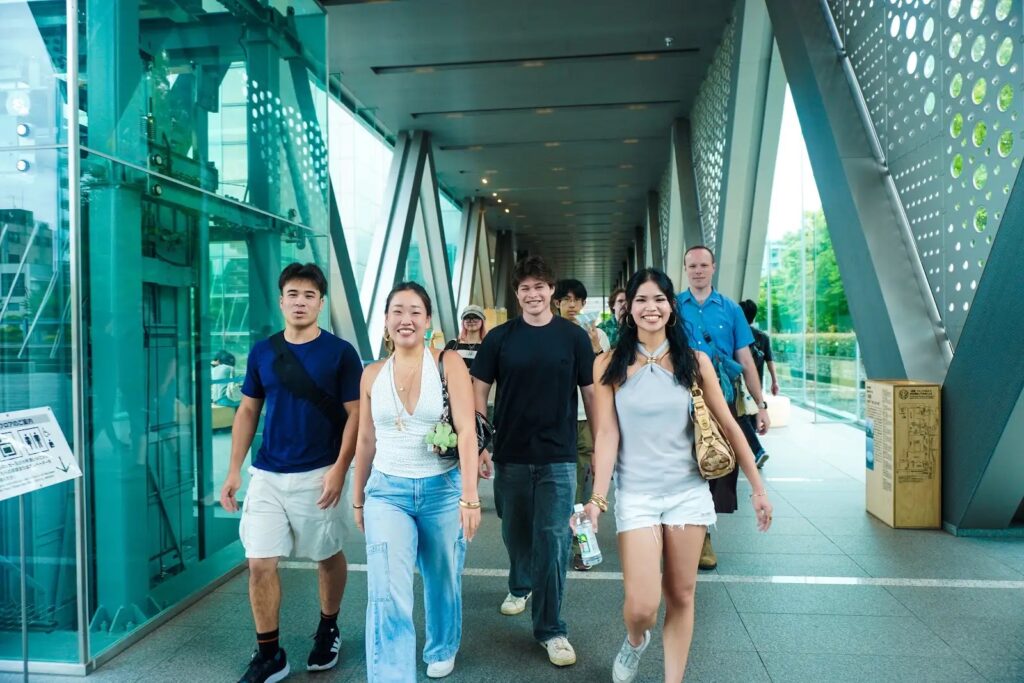
They also went to a museum dedicated to the art of Yayoi Kusama, whose far-ranging visions include mirrored “infinity rooms,” sculptures, and works on paper.
The faculty leader for the trip, Assistant Professor of Languages and Applied Linguistics Saori Hoshi said the immersive trip allowed students to test interpretations, encounter unfamiliar perspectives, and connect learning to real people, places, languages, and histories.
She also described the way the students experienced translanguaging, a practice in which multilingual speakers draw flexibly on their languages to support understanding and communication. “During museum visits, guides spoke only Japanese, making some details difficult for students to follow,” Hoshi said. “Japanese-speaking peers moved naturally between Japanese and English, clarifying information, explaining unfamiliar ideas, and facilitating conversations about the artworks. Translanguaging became a collaborative practice that valued multilingualism as a strength and enabled fuller participation in complex cultural and artistic experiences.”
The museums offered lessons that extended beyond the artworks themselves.
“There are so many little nuanced things that you cannot find in a classroom,” Finn Harkness (Merrill ‘26, applied linguistics), said. “You notice the way people talk to each other and interact in museums, and the way they physically appear while looking at art that impacts them.”
At the Tokyo University of the Arts, the cohort examined how Japanese artists have used art to heal, preserve memory, and confront trauma in the wake of the atomic bombings and the Fukushima nuclear disaster.
They engaged deeply with Japanese artist and filmmaker Hikaru Fujii’s video installation The Classroom Divided by a Red Line, which explores discrimination and trauma following the 2011 Fukushima nuclear disaster.
In the installation, a Japanese teacher divides a group of schoolchildren, labeling them as inferior or superior depending on whether they live outside or inside the ‘zone.’
Professors Hikaru Fujii and Ryohei Kan invited the group to their lectures at the Tokyo University of the Arts during the trip. Professor Hoshi discussed this artwork in the UCSC classroom prior to the lecture at Tokyo University of the Arts.
“Listening to Hikaru Fujii and Ryohei Kan was really effective because I was able to understand why and how they make their artworks,” Misaki Kinoshita said. “I think it is really nice to hear the actual artist explain their thinking, because although we got the general idea in class, listening to them gave me a deeper understanding.”
Students applied their developing “trained eye,” examining not only what was aesthetically striking but also the artist’s background, experiences, and the social, cultural, political, and historical conditions surrounding each work, Hoshi said.
“I was impressed by how confidently students moved beyond calling art ‘cool’ or ‘beautiful,’” Hoshi said. “They observed closely, asked thoughtful questions, and connected visual details to artistic intention and lived experience. Many reflected that seeing the works in person transformed the way they view and understand art, which is not isolated from the world but shaped by people, places, histories, and ideas.”
Nibutani: Where language lives
From Tokyo, the group flew to Sapporo before traveling to Nibutani, a vital cultural hub for the Indigenous Ainu people, for workshops in traditional food, textiles, and woodworking, as well as a language lesson with local Ainu artists.
If Tokyo gave students new ways to see, Nibutani gave them new ways to listen.
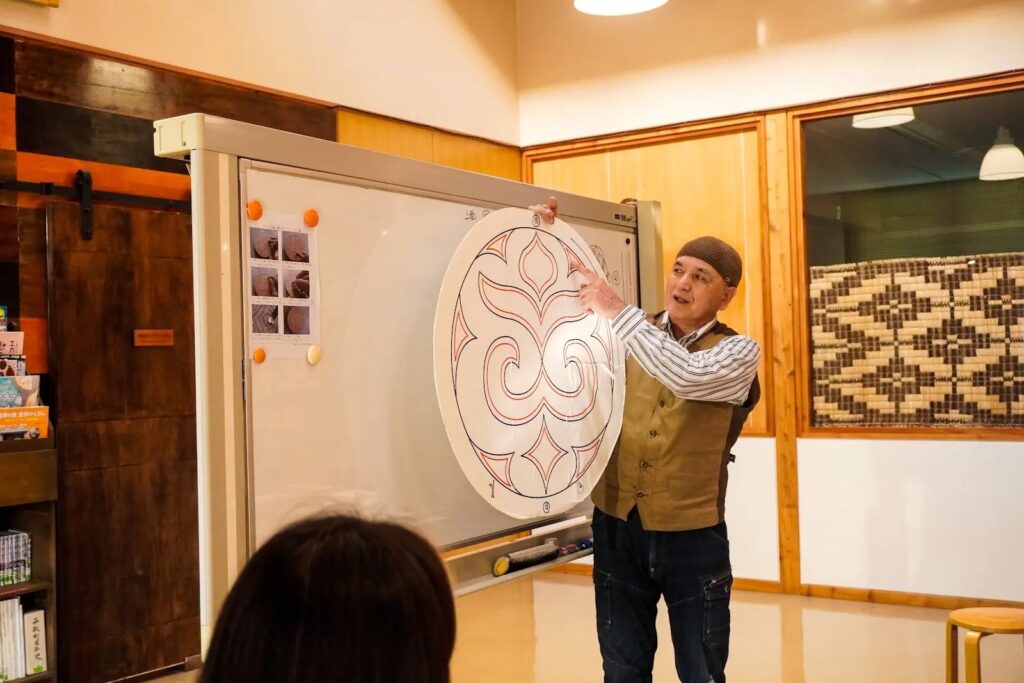
Rather than memorizing vocabulary lists, as they would in a classroom setting, students encountered the Ainu language through music, play, and conversation.
For Finn Harkness, the moment that stayed with him happened not in a workshop but at the dinner table.
“They had four generations of their family there with us, and we got to speak to all of them as if they were our close friends,” Harkness said. “This really put into practice and showed how important the community is to the Ainu.”
Miles Morrow (Stevenson ‘26, language studies) also remembered that evening as a highlight of the trip.
“This was truly a great moment,” Morrow said. “Getting to spend time with and further get to know everyone was so much fun and made me very happy … The word for this day was 家族 (kazoku, family). I think it really brought all of us closer together.”
For Kei Hartzberg (Cowell ‘28, computer science and business management economics), the experience offered a deeper understanding of a culture that is often overlooked.
“Meeting people who are actively preserving Ainu traditions made the experience feel personal and meaningful rather than simply academic,” Hartzberg said. “It taught me the importance of stepping outside familiar experiences and engaging with cultures in ways that can reshape how I understand both Japan and myself.”
Students learned some of the Ainu language through vocabulary, numbers, traditional songs, and a language game.
“Compared with simply reading a list of words in a classroom, using the language through music and play made it feel much more alive,” Hartzberg said. “It also showed me that language is not only a way to communicate information, but also a way to preserve culture, memory, and community.”
For Hartzberg, “the word that became the most meaningful here to me was pirika, meaning ‘good’ or ‘beautiful’ in Ainu.”
“The English translation communicates the basic meaning, but it does not fully capture how flexible and expressive the word felt in context,” Hartzberg said.
For Lisa Ido (College Nine ‘28, business management economics and mathematics theory and computation), the trip confirmed something she had begun to suspect in the classroom: language and culture cannot be separated.
“Language cannot be learned in a vacuum because language is always influenced by culture,” Ido said. “Learning a new language does not just teach a new way to speak; it teaches a whole new way of thinking.”
Throughout the trip, students kept field notes — some typed, some handwritten — to capture observations that might otherwise have been lost between one museum and the next.
“For me, the daily journals were really helpful,” Harkness said. “It can be easy to mindlessly walk through museums and forget everything as soon as you leave. But by thoughtfully reflecting on what impacted me during the day, I feel like I was able to better hold on to important memories and learn new things.”
The academic work continued after the group returned home. Students completed a museum report analyzing an artist and artwork from their Tokyo visits, as well as a self-reflection examining how the museum and Ainu cultural experiences shaped their critical literacy and linguistic skills.
Together, the trip and the assignments gave students a way to hold onto ten days that changed how many of them understood art, language, culture, and the possibilities of learning far beyond the classroom.
Later this year, Employing Humanities will fund another group of UC Santa Cruz students who will have the opportunity to connect classroom learning with firsthand experience through an immersive study trip to Senegal.
After completing the course History 137H: History and Cultural Heritage in Africa, ten students will examine how history, memory, and power shape the recognition of African UNESCO World Heritage Sites while traveling to Dakar, Saint-Louis, and the Saloum Delta.
Led by Assistant Professor of African History Thiago Mota and Professor of History Greg O’Malley, the December immersion will bring students into conversation with local communities and heritage professionals, offering an opportunity to explore Senegal’s rich cultural heritage while deepening their understanding of Africa’s place in global history.