Health
Understanding how jellyfish eyes first form and regenerate to reveal paths for new human therapies
National Institutes of Health awards just over $2 million to UC Santa Cruz evolutionary biologist Aide Macias-Muñoz for a five-year study of the genetic mechanisms that lead to complex traits like eye regeneration
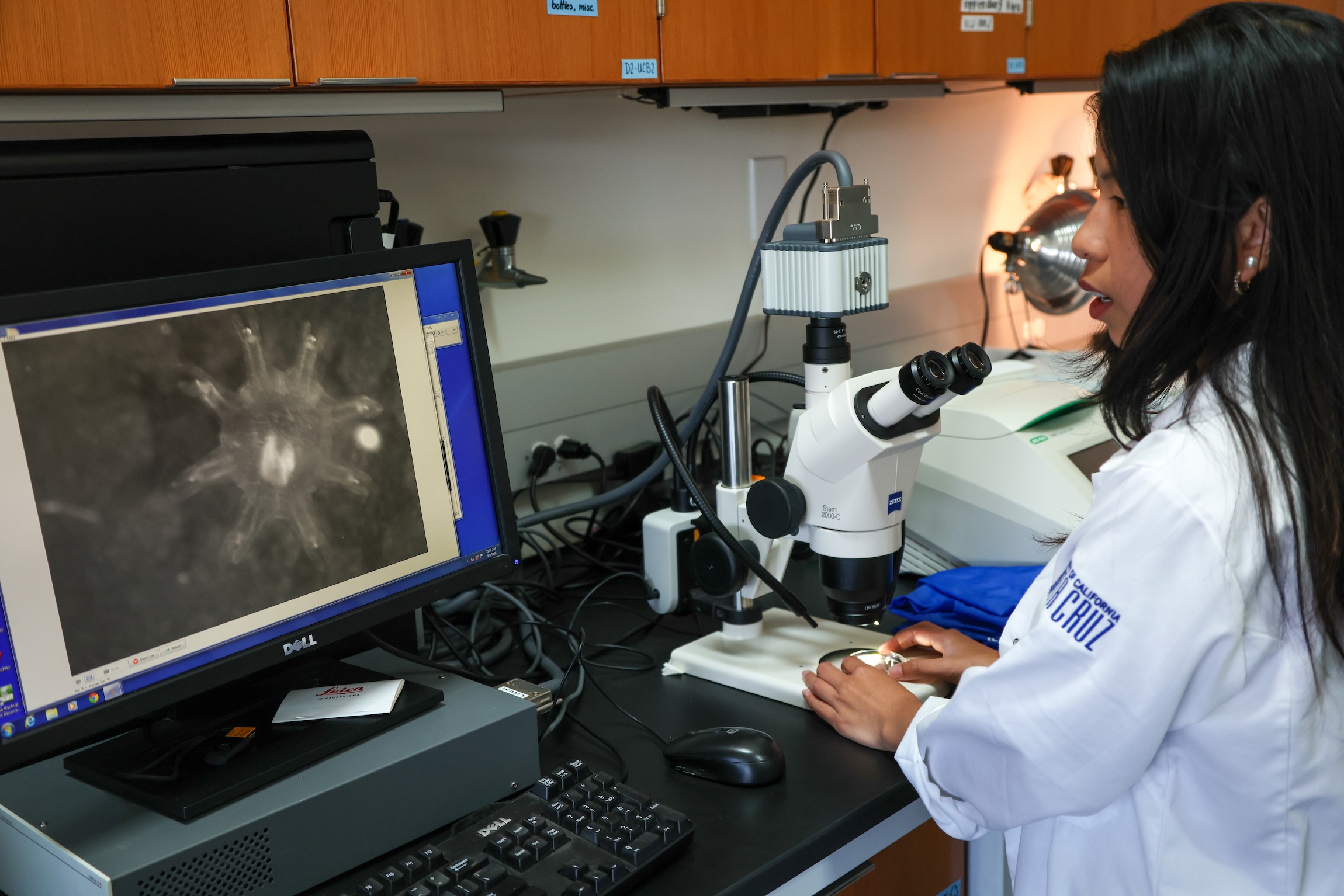
Feresa Corazon Cabrera, a postdoctoral fellow in the Macias-Muñoz lab, looking at a juvenile moon jellyfish. The bright spots in the arm grooves are sensory structures called rhopalia, where their eyes are housed.
Photos by Carolyn Lagattuta
Press Contact
Ask someone to imagine being any type of animal that they want, and odds are few would say, “jellyfish.” But many species of cnidarians possess an envious and innate ability that is at present unthinkable to humans: regrowing an eye.
That’s why evolutionary biologist Aide Macias-Muñoz at the University of California, Santa Cruz, researches these ethereal creatures—to understand the genetic mechanisms that lead to complex traits like eye regeneration. With just over $2 million awarded by the National Institutes of Health in August, the Macias-Muñoz Lab will spend the next five years on this quest.
The ultimate goal is to harness regenerative ability for therapeutic purposes, like developing new gene therapies for neuronal and retinal degeneration, or disease caused by cell death or injury. But first, as Macias-Muñoz states, we need to comprehensively understand the biological mechanisms, cell types, and genetics that enable the regeneration of different tissues.

“Existing studies on regeneration are limited to a handful of model organisms, and just a few candidate genes have been identified,” said the assistant professor of ecology and evolutionary biology. “This has led to a blind spot in our understanding of whether the genetic mechanisms that dictate the ability to regenerate are fixed, or whether regeneration can happen in a number of ways.”
To address this, her lab does comparative investigations into the cellular and molecular mechanisms of eye development versus regeneration. By characterizing the microscopic trajectories of the contrasting processes, Macias-Muñoz and her team hope to discover critical insights into shared or unique cell types—and the genetic machinery that underpin the regeneration process in animals.
Specifically, they aim to identify cell types, gene regulatory networks, and signaling pathways that are crucial to regeneration across jellyfish. This will be the first study to characterize changes at the single-cell level during cnidarian eye development and regeneration, Macias-Muñoz said.
“Our approach will reveal how similar or different the cells and genes used for regeneration are across species,” she explained. “This knowledge can be used to develop approaches for manipulating regenerative ability in animals that lack it.”
The NIH funds, which began this month, were a Maximizing Investigators’ Research Award (MIRA), a program of the National Institute for General Medical Science (NIGMS). The prestigious five-year grant provides flexible, long-term funding for research programs.