Health
How a gut virus hijacks mucus production to slip past the body’s protective barrier
New study reveals how astroviruses use goblet cells as an escape route from the small intestines to evade host immunity and enhance spread and transmission, presenting a new path for treating pediatric diarrhea.
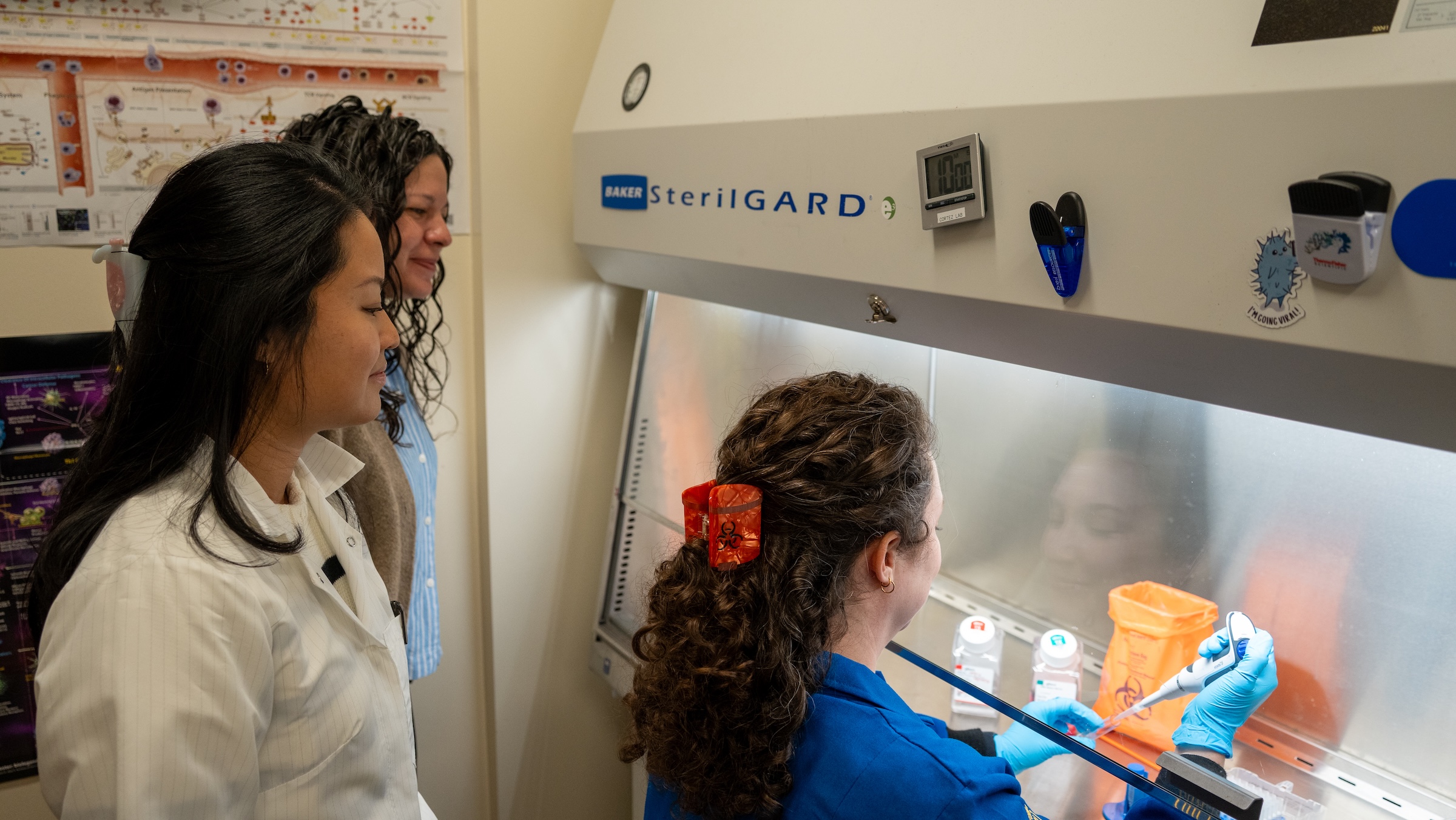
UC Santa Cruz graduate student Melanie Kirkpatrick, seated, prepares to purify mucin from cells with guidance from fellow graduate student Michelle Pablo (wearing white) and Professor Valerie Cortez.
Credit: Cortez Lab
Press Contact
Key takeaways
- This study reveals a unique and stealthy exit strategy used by astroviruses. Rotavirus and norovirus, which also infect the small intestines, are known to break through the organ’s inner lining in order to increase spread within the body and among other hosts.
- In mouse and human cell-culture models, the research team found that blocking mucus secretion reduced virus release, while stimulating it increased virus levels—revealing astrovirus’s escape route.
- Uncovering this exit mechanism provides potential new targets for developing treatments against pediatric diarrhea, a leading cause of death for children around the world under the age of 5.
Among the various viruses that sicken your gut, some at least leave behind a tiny path of cellular destruction as they replicate, implicating the guilty pathogen. Both rotavirus and norovirus invade the small intestines, multiply there, and can break through the organ’s outer lining as one way of proliferating in the body.
Astroviruses, which infect the same organ and cause pediatric diarrhea worldwide, have a slicker strategy that avoids tissue damage. In a new study published in the Proceedings of the Library of Science: Pathogens, a team of cell biologists at the University of California, Santa Cruz, report the astrovirus’s exit strategy. In a few words, it can be summed up as, “follow the mucus.”
The team discovered that astrovirus relies on mucus secretion from goblet cells as the coordinated path to completing its replication cycle. The finding reveals potentially new targets for strategies to treat pediatric diarrhea, according to the paper’s senior author, Valerie Cortez, a professor of molecular, cell, and developmental biology at UC Santa Cruz.
“Together, these findings highlight a new facet of enteric virus-host biology that allows for the efficient release of virus particles,” Cortez said. “Prior to our study, the pathway by which astroviruses exit the cell was largely unknown, unlike for other major enteric viruses like norovirus and rotavirus.”
Gaining on a deadly virus
The study builds on the Cortez Lab‘s previous discovery that astrovirus targets the intestine’s goblet cells. The single-stranded RNA virus infects birds and mammals, and in humans, is a major driver of pediatric diarrhea—especially in parts of the world with poor water access. Globally, diarrhea is a leading cause of death for children under the age of 5.
Goblet cells create a thin layer of mucus that insulates the intestinal wall, which keeps most microbes, pathogens, and whatever we ingest from seeping into the rest of the body, according to the study’s lead author, Natalie Pedicino. How astrovirus gets past this protective system, and indeed leverages it, was the focus of Pedicino’s Ph.D. thesis in the Cortez Lab.
This viscous process was also the subject of a lightning talk Pedicino gave in 2024 that took her to the UC-wide Grad Slam championship, where Ph.D. students from each campus competed for top honors by distilling their research into a presentation of three minutes or less. Pedicino’s talk was titled, “From Mucus Factory to Virus Factory: A Novel Gut Virus’ Global Impact on Children.”
“We discovered this novel mechanism where astrovirus essentially hijacks goblet cells,” Pedicino said. “This finding is exciting, both for the field of astrovirus research and for gut viruses as a whole because it reveals another viral exit strategy.”
Exit route equals new possibilities
The team used both mouse and human cell-culture models to see if mucus served as a path for astrovirus to exit from goblet cells and spread. When they blocked mucus secretion, it reduced the level of virus release. When they stimulated mucus secretion, virus levels increased. Identifying this mechanism has broader implications for cellular processes that allow certain viruses to evade host immunity and enhance spread and transmission.

For example, Cortez explained that “hiding” in mucus could help a virus avoid detection or enhance entry into new cells, similar to how rotavirus and norovirus form membrane-cloaked clusters to slip into a cell. Previous studies have shown that mucus stabilizes the temperature of human astrovirus, perhaps aiding its spread within and between hosts.
“This discovery identifies a unique exit strategy for an enteric virus that allows it to spread without having to bust open and kill its host cell,” Cortez said. “Understanding this host-virus interaction during the replication cycle can provide new insights into pathogenesis and potentially new targets for treatment strategies that prevent astrovirus spread.”
Career trajectories and collaboration
Pedicino, the Cortez Lab’s first Ph.D. graduate, is now a tenure-track biology instructor at West Valley College in Saratoga, Calif. Co-authors Jacob Gulman and Nicole Heredia-Osuna are former UC Santa Cruz undergraduates who worked as research specialists in Cortez’s lab. Gulman and Heredia-Osuna are now in graduate programs, respectively, at Stony Brook University and University of Nevada, Reno.
The team also collaborated with researchers at the Baskin School of Engineering. Rebecca DuBois, professor of biomolecular engineering, and her graduate student Adam Lentz shared reagents with the Cortez Lab, including purified human astrovirus spike protein and engineered antibodies that detect human astrovirus.
UC Santa Cruz’s Flow Cytometry Core, Microscopy Center, and Vivarium played critical roles for this study, which was funded by a Maximizing Investigators’ Research Award that Cortez received earlier this year from the National Institutes of Health.