Social Justice & Community
The long journey home
Ancestral remains are finally returning to the Naga people of Southeast Asia, after being held for over 100 years in a London museum. Anthropology Professor Dolly Kikon shares how this moment came about and what it says about the opportunity for healing through repatriation.
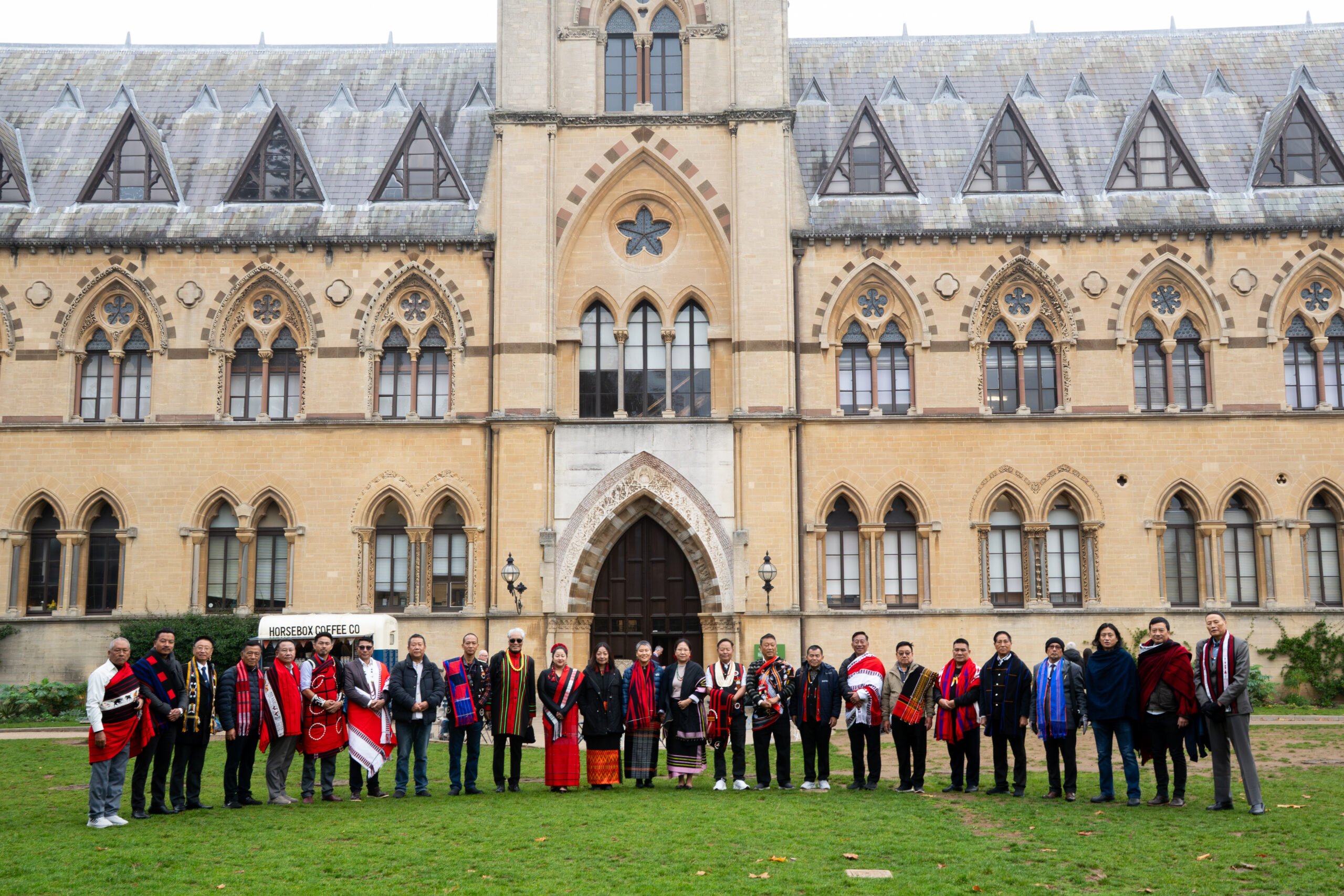
Members of the Naga delegation gather outside the Pitt Rivers Museum. Professor Dolly Kikon is at center in front of the museum door. Photo courtesy of Recover Restore and Decolonise (RRaD).
Earlier today, a delegation of leaders and scholars representing Naga tribes from across northeastern India gathered at Oxford University’s Pitt Rivers Museum to receive 39 Naga ancestral remains. The remains had been taken by British administrators during the colonial era and displayed publicly in the museum until as recently as 2019.
The day’s events were preceded by a private mourning ceremony and gathering earlier this week. This long-awaited return is the first repatriation of Indigenous human remains to take place in India, and one of the biggest community-led, one-time repatriation efforts in Asia.
Dolly Kikon, a UC Santa Cruz anthropology professor and director of the Center for South Asian Studies, is supporting the process as part of the Recover Restore and Decolonise team (RRaD), a community-centered repatriation research group constituted by the Forum for Naga Reconciliation (FNR). The FNR, a Naga peace forum, has functioned as the facilitator between the Pitt Rivers Museum and Naga tribal leaders, elders, and the government of Nagaland to repatriate the remains of Naga ancestors back to the Naga homeland.
Kikon grew up in the Indian state of Nagaland, a tribal state in Northeast India, and recalls first learning about the Pitt Rivers Museum as a child. She saw photos of the Naga ancestral remains in a book titled The Nagas, by Julian Jacobs, published in 1990. The Pitt Rivers Museum has the largest collection of Naga belongings in the world, housing more than 7,000 cultural items. Among that collection were Naga ancestral human remains, many taken under duress.
As Kikon grew up and became an anthropologist—whose work focuses on decolonial anthropology, ecology, and militarization—she found herself purposefully avoiding entering museums that displayed Naga human remains.
“Why would I go to a museum to see a display that someone else had written about my people, when I was aware that Naga history required a much deeper engagement?” she explained. “For many Indigenous people, having your story told by colonizers, in spaces like museums and in academic literature, is a universal experience of ongoing colonial violence.”
But about six years ago, something began to shift. In 2020, Kikon came across an article in The Guardian reporting that The Pitt Rivers Museum at Oxford University had removed human remains from display, following an ethical review.
“I immediately wrote to the museum director to initiate conversations about repatriation,’” Kikon recalled. “The director wrote back right away, and that’s how this all began. From there, it was about handing over the process to the Naga communities, tribal leaders, and elders. It has been a massive community effort.”
Initially, the RRaD team started with surveys, interactions, and public workshops across the Naga homeland, aiming to build consensus on approaches to repatriation. Researchers also learned from other Indigenous repatriation efforts around the world, including those of Hawaiian activist Edward Halealoha Ayau and the Aboriginal Australian group Return, Reconcile, Renew. Once there was a sense of collective consent among the Naga people for how to bring their ancestors home, FNR and the RRaD team worked to pull together the paperwork they’d need to make it happen.
“For Indigenous people who work on repatriation, the burden of proof in providing evidence for repatriation claims falls on us,” Kikon explained.
In June 2025, the first Naga delegation traveled to Oxford to officially present their repatriation appeal. The delegation comprised Naga tribal leaders, elders, scholars, and members from the FNR and RRaD. In a statement this past September, the Forum for Naga Reconciliation, tribal leaders, and the repatriation working group described what this effort has meant to them.
“Repatriation for the Nagas is not simply about bones and ancestral remains finding their way back to the land, but importantly, it is about memory returning to where it belongs.”
In the days to come, after the ancestral remains finally arrive in Nagaland, they will be laid to rest in the capital city of Kohima, alongside a new monument dedicated to Naga unity and healing. Tribal leaders and elders agreed on this approach unanimously, a testament to the power of repatriation to unite people as they heal from colonial trauma.
“Bringing the remains home allows the Nagas to say, we will never forget what happened, but we will not allow that injustice to make us permanently resentful,” said Rev. Dr. Wati Aier, Convenor of the Forum for Naga Reconciliation, in remarks this past September. “We will not allow the past to victimize us in the present. Memory will be redeemed, because it is transformed from a source of trauma into a symbol of resilience and peace.”
FNR members and the RRaD team believe that healing through repatriation can ultimately help to support the regional peacebuilding process.
“Colonization is a huge trauma and a deep structural violence that creates division, and for the Nagas, it has left us as a deeply wounded society,” Kikon said. “Repatriation is an important opportunity to come together to honor our ancestors and a chance to look at ways of restoring our own spirit. Repatriation helps us to look at the past and learn how to end the violence of dehumanization and begin to heal and become whole.”