Climate & Sustainability
UC Santa Cruz scientists successfully swap all fish products in aquafeed to boost sustainable fish farming
Researchers replaced all fish-derived ingredients in an aquafeed for farmed rainbow trout with a combination of microalgae and canola oil. The diet could provide a new alternative that eliminates the need for feed ingredients sourced from wild fish.
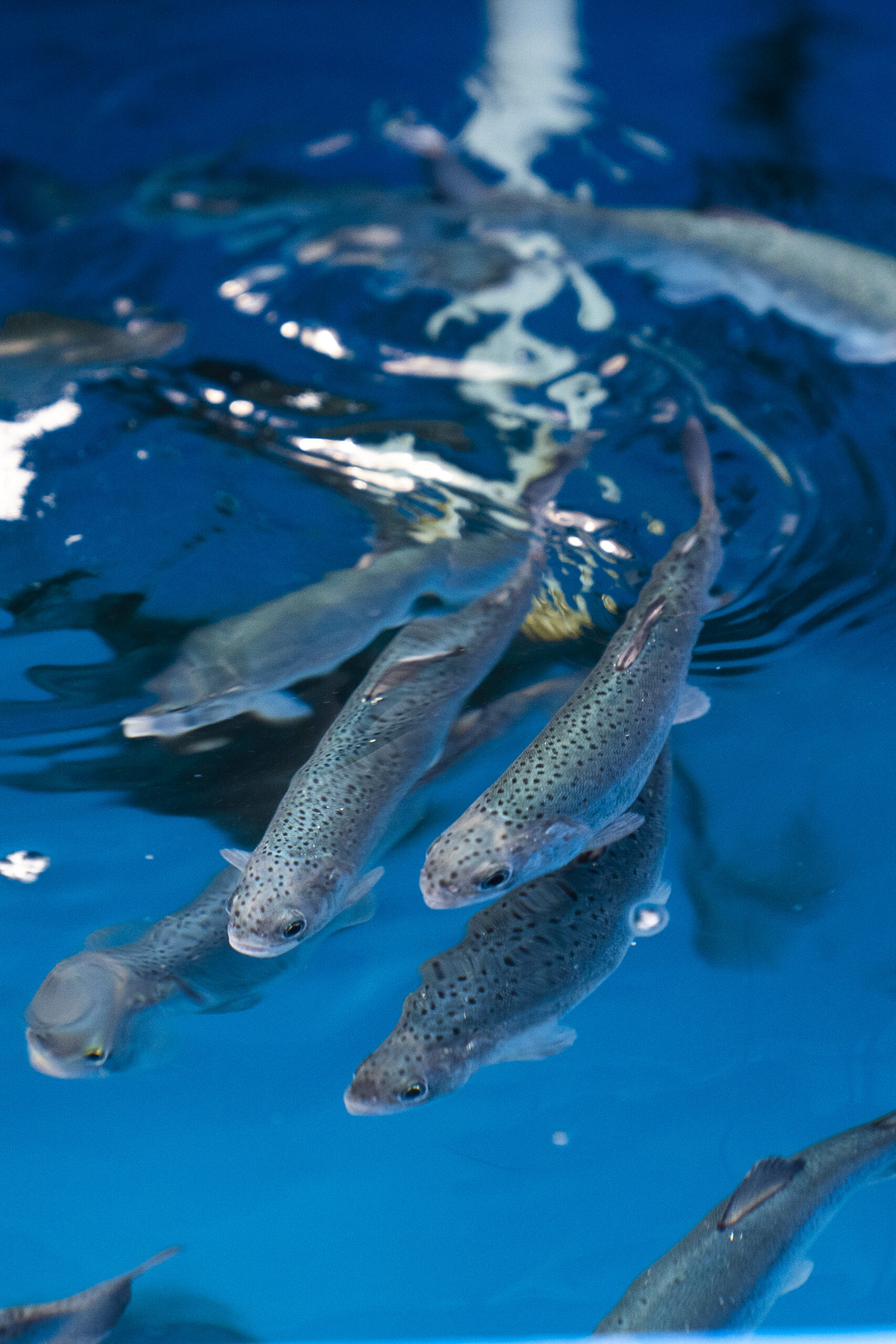
Global fish production and consumption have hit new heights, according to the United Nations. People worldwide are consuming much more fish per capita, and more than 23 million people now work in the aquaculture industry. That booming business is putting pressure on the world’s oceans.
Most of today’s global fish production comes from farms, which raise fish on a food called “aquafeed.” Producers make the main components of that feed — fishmeal and fish oil — from small fish species such as sardines and anchovies. Though those fish may be low on the food chain, demand for converting them into fishmeal and fish oil reduces their availability as wild food for larger ocean fish, seabirds, and marine mammals while reducing available food supplies for people in countries that rely on them. Climate change adds another layer of complexity, warming oceans and disrupting ecosystems.
Together, those factors have pushed fishmeal supplies to the brink: As demand for fish grows, feed supply has plunged near the lowest level in a decade.
Thus far, replacing all fish-derived products in aquafeed has proved difficult; scientists and industry have tried land-based plant and animal products, yeasts, and even bugs. But there are several major problems. Some of these ingredients are too expensive or have an imbalanced nutritional profile for fish. Others can change the nutritional quality of the resulting fish fillet. And carnivorous fish like trout, that enjoy eating fish, sometimes notice the difference and eat less when it’s removed from their diets.
Now there’s a promising new alternative that might help to address those concerns. In a new paper published in the journal Antioxidants, a team at UC Santa Cruz successfully swapped all fish-derived ingredients in aquafeed for a combination of microalgae and canola oil. In a more than two-month study of rainbow trout, they found the combination did not reduce growth or digestion in farmed fish, suggesting their diet could provide a viable, sustainable, and economic alternative to current aquafeeds. Trout raised on the diet also seemed to retain the same nutritional quality for humans as those fed fishmeal and fish oil.
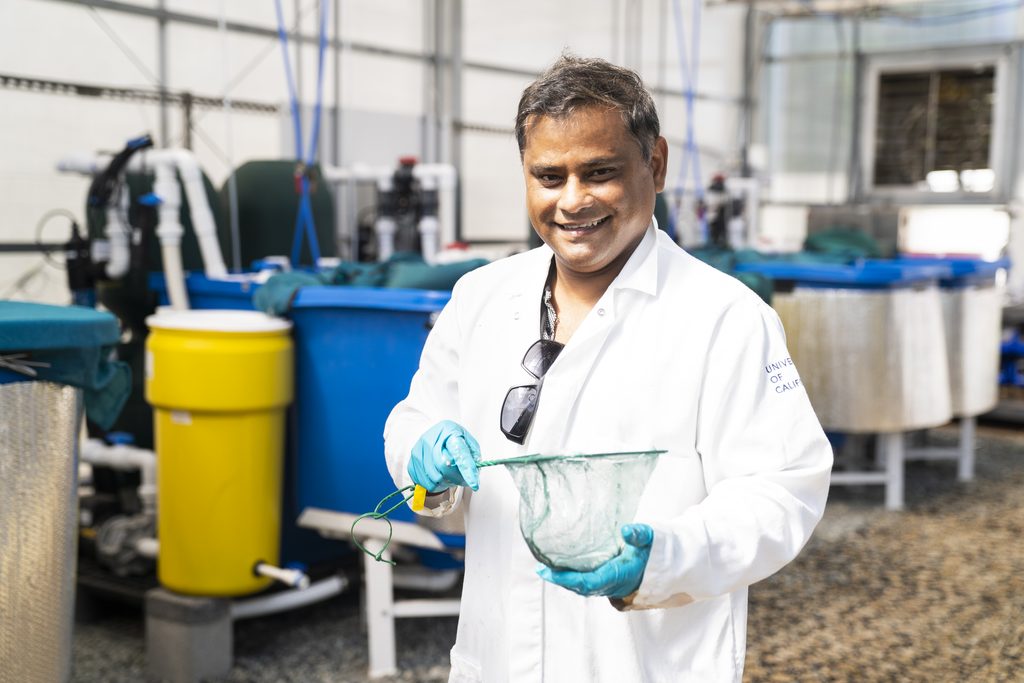
“This is really groundbreaking,” says Pallab Sarker, an associate professor and sustainable aquaculture scientist who worked on the research. “The future of feeding the world should not come at the expense of our ocean, and finding sustainable alternatives is essential to producing more food without depleting the marine resources we depend on.”
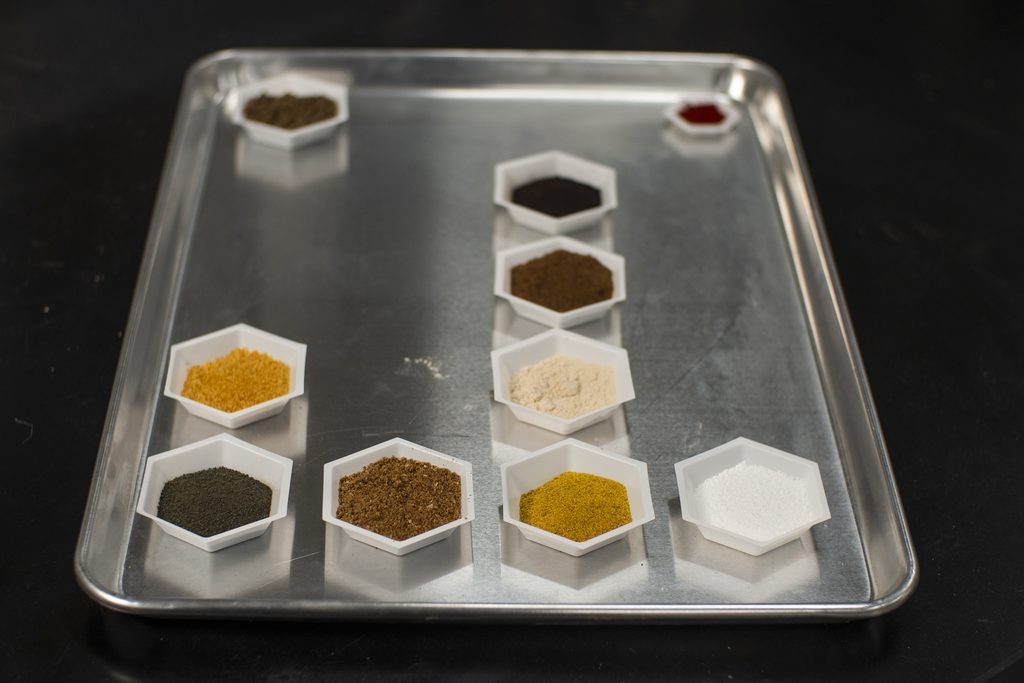
Fishmeal and fish oil provide essential nutrients for growing fish: protein, lipids, amino acids, antioxidants, and omega-3s. Microalgae, Sarker and his team found, could provide the same nutrients. In previous research, researchers used a microalgal byproduct, Nannochloropsis oculata, as a substitute for fishmeal in feed. They added taurine, a nutrient also found in fishmeal, and lecithin to the feed, which helped the fish readily accept and consume the microalgae-based diets. The team found that these substitutions successfully supported a similar level of fish growth as fishmeal.
But researchers also wanted to test whether they could replace another integral fish-derived ingredient, which provides an important nutrient to feed: fish oil. In the new study, the team built upon their fishmeal-free feed by testing the addition of both oil and whole-cell forms of another microalga, Schizochytrium, in combination with canola oil, to determine if it could replace fish oil too. Combining two species of microalga in one feed proved to be a winning solution, particularly when using the whole-cell form of Schizochytrium.
It’s an exciting development that could significantly reduce pressure on wild fish supplies if scaled up. California Sea Grant and the United States Department of Agriculture funded the research.
“If we can reduce the use of of ocean-derived nutrients, and if we can actually replace it with something like marine microalgae, where you can have more control over the stability of your yield, you’re going to end up with more stable economic outlook for the producers of the feed ingredient, compared to increased volatility of fishmeal and fish oil supplies and prices as our oceans are warming,” says Anne Kapuscinski, the director of the Coastal Science and Policy Program at UC Santa Cruz and one of the study’s authors. “You’ll also have less potential for harm to marine biodiversity.”
Microalgae is an enticing alternative because it is an “underused byproduct,” according to Sarker, and can be recycled from the manufacture of other products, such as human food supplements or dye. Tapping into these microalgae supplies can still be costly, he said, in part because reuse of byproducts from current commercial production hasn’t been established on a wide scale. But diverting microalgae leftovers to farmed fish production would give the waste product value of its own, making it easier for microalgae-based feeds to compete economically with conventional feeds.
Already, the new microalgae-based feed product the team developed appears potentially economically cost-competitive with current aquafeed products. Microalgae production also doesn’t compete with other food sources for fresh water, as it can be grown in saltwater or briny water.
“The next step is to move from promising experimental results towards practical applications,” explains Sarker. “We need to evaluate these feeds at larger scales, plus other microalgal byproducts.”
The team recently conducted trials at the Mt. Lassen Trout Farm and a California Department of Fish and Wildlife fish hatchery. Those tests showed no statistically significant growth difference between fish fed with commercial feed versus the lab’s alternative. If further trials produce similarly promising results, the implications could be significant for the future of fish farming.
“This is more than a new fish feed; it is a step forward, reimagining how we produce food for a global population while protecting the oceans that sustain us,” said Sarker.