Engineering
-

‘Digital twins’ project will help clean up space junk, repair and decommission spacecrafts
Professor of Electrical and Computer Engineering Ricardo Sanfelice and a team of researchers have been awarded $2.5M to model complex aerospace engineering problems.
-
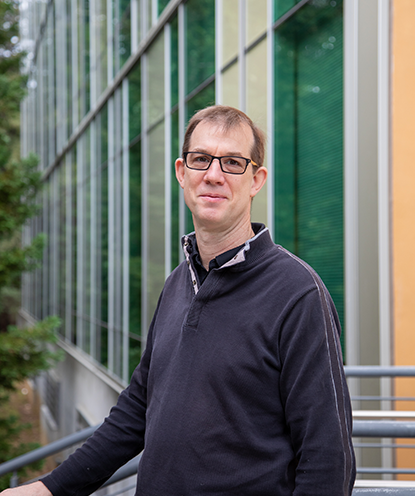
Center for Research in Open Source Software welcomes James Davis as new faculty director
Professor of Computer Science and Engineering is the new faculty director of the Center for Research in Open Source Software (CROSS).
-
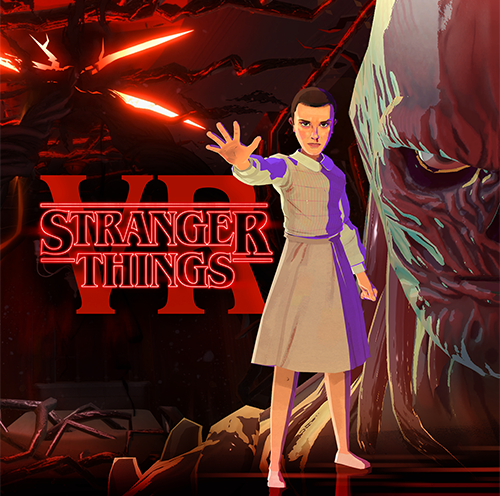
Stranger Things VR game co-written by UCSC’s Samantha Gorman launches in partnership with Netflix, Meta
A new virtual reality (VR) game set in the world of Netflix’s hit series Stranger Things launches today — and UC Santa Cruz Assistant Teaching Professor of Computational Media Samantha Gorman is a key creative mind behind it as the game’s co-writer and narrative director.
-

Protein designer awarded $2.5M to develop bioluminescent protein for deep tissue imaging
Assistant Professor of Biomolecular Engineering Andy Yeh was awarded a nearly $2.5 million grant from the Chan Zuckerberg Initiative to develop completely artificial enzymes that can produce bioluminescence in the body for deep tissue imaging.
-

Innovation at the intersection: An alum’s trailblazing ventures in tech, film, and social change
Dr. Kortney Ryan Ziegler is an award-winning tech entrepreneur, a filmmaker and producer, a social justice advocate, and a scholar.
-

Widespread machine learning methods behind ‘link prediction’ are performing very poorly, study shows
New research from UC Santa Cruz Professor of Computer Science and Engineering C. “Sesh” Seshadhri published in the journal Proceedings of the National Academy of Sciences establishes that the metric used to measure link prediction performance is missing crucial information, and link prediction tasks are performing significantly worse than popular literature indicates.
-
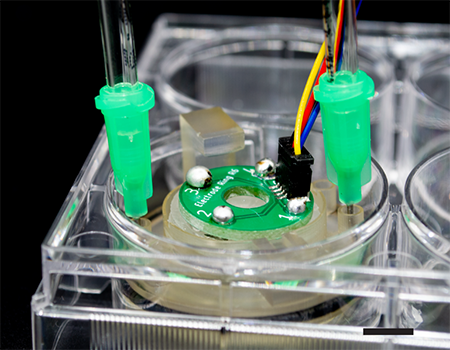
Bioelectronics enable precise control of organoids for better understanding of neuro diseases, neuron circuits
UC Santa Cruz researchers have developed a new plug-and-play bioelectronics system that enables researchers to precisely control neuronal activity in cortical organoids, which will help unlock new discoveries on how brains form neural circuits and the underpinnings of neurodevelopmental and degenerative diseases.
-

2023-24 CITRIS UC Santa Cruz Tech for Social Good Program’s student project teams kick off
The 2023-24 CITRIS Tech for Social Good program at UC Santa Cruz started in January with kick-off meetings with the winning technology development track teams.
-

Innovative PET technology will enable precise multitracer imaging of the brain
UC Santa Cruz Associate Professor of Electrical and Computer Engineering Shiva Abbaszadeh is developing technology that will enable precise multitracer positron emission tomography imaging of the human body’s most complex organ with the support of a $4 million NIH grant.
-

UC Santa Cruz’s Center for Coastal Climate Resilience partnering with EY on Open Science Data Challenge on Coastal Resilience for students
Climate change is here, and so are its impacts on our communities. Globally, coastal hazards produce increasing costs, often to the most vulnerable populations. That’s why UC Santa Cruz’s Center for Coastal Climate Resilience (CCCR) and the University of California Disaster Resilience Network (UCDRN) are partnering with EY on its 2024 Open Science Data Challenge,…
-

Insights from UCSC-made COVID-19 tracking tool will guide the future of studying pathogens in real time
A new paper by a team of UCSC pathogen genomicists offers guidance for the future of web tools for tracking pathogen evolution.