Health
Fueling the biotech flywheel with fundamental discoveries and driven graduates
UC Santa Cruz deepens industry engagement to underscore its vital role in contributing basic research and tomorrow’s talent, convening its first international RNA biology conference on August 18
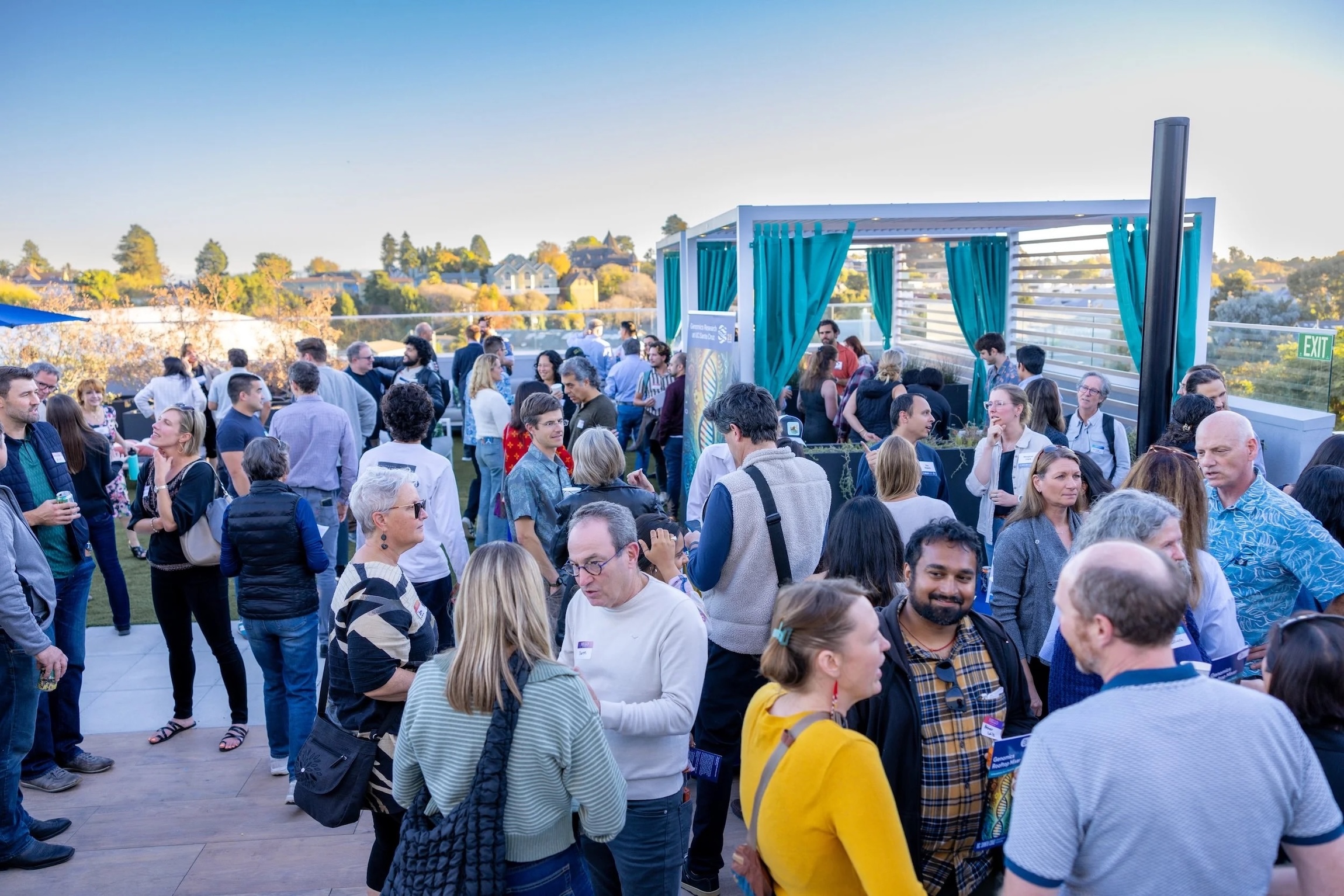
The UC Santa Cruz Genomics Institute partnered with Santa Cruz Works to host a rooftop mixer in late October 2025 that fostered new connections among researchers, local entrepreneurs, investors, and community members.
Credit: Santa Cruz Works
Press Contact
Key takeaways
- UC Santa Cruz is strategically elevating its engagement with the biotechnology sector to emphasize its essential role in producing fundamental research and future talent.
- By attending and hosting major international forums, the campus is forging direct connections between its researchers and industry leaders, while bridging the gap between basic lab discoveries and real-world medical applications.
- The success of UC Santa Cruz alumni confirms the campus’s highly relevant biotech-research programs. This strong pipeline of graduates, combined with ongoing faculty innovation, underscores UC Santa Cruz’s growing influence on the future of RNA biology and therapeutics.
This summer marks what campus leaders intend to be a new chapter in the University of California, Santa Cruz, engaging more deeply and strategically with the wider biotechnology ecosystem that encompasses the many companies and peer research institutions driving advances in human health.
In recent years, UC Santa Cruz has increasingly ramped up efforts to present the campus’s role as an engine of fundamental-science discoveries that add to the body of knowledge that ultimately result in new treatments. Last fall, the Genomics Institute hosted a rooftop mixer that brought together scientists and students from campus with entrepreneurs, investors, and representatives from prominent firms like 10X Genomics, Myriad Genetics, and Oxford Nanopore Technologies.
Biomolecular engineering professor David Haussler, the institute’s scientific director, opened the mixer by reflecting on the quarter-century of advances in human health and environmental conservation unleashed after UC Santa Cruz posted the first draft of the human genome online in 2000. Multiple members of the UCSC RNA Center, affiliated with the Genomics Institute, were at the mixer to underscore the connection between basic discoveries in RNA biology and emerging applications.
Taking our rightful place
More recently, the campus attended the world’s largest biotech gathering: the annual BIO International Convention. At this year’s four-day event in San Diego in late June, leaders from UC Santa Cruz’s Science Division, Baskin School of Engineering, and Innovation & Business Engagement Hub hosted conversations with alumni now in biotech, industry executives, and potential partners.
Next to the convention center, a reception on June 24 featuring Nobel laureate Carol Greider, professor of molecular, cell, and developmental biology, provided a warm and friendly environment to strengthen some of those connections and lay the groundwork for future alliances.
“The real value isn’t any single meeting, it’s the evolution of these conversations over time,” said Nathan Westrup, executive director of business engagement for the campus. “Partnerships in this industry take time to mature, and BIO is where the relationships that pay off three and five years out get their start.”
UC Santa Cruz Foundation member Greg Reyes—a longtime biopharmaceutical executive who graduated from UC Santa Cruz and went on to earn both an M.D. and Ph.D. in pharmacology from the Johns Hopkins University School of Medicine—provided the support that made participation in the massive event possible. Reyes understood the need to raise UC Santa Cruz’s profile in the life-sciences space to ensure that its role in fueling past and future progress is widely recognized.
“Our distinctive strength is foundational science that feeds the industry’s pipeline,” Westrup explained. “UC Santa Cruz has been a global leader in genomics since the Human Genome Browser, and that legacy now runs directly into RNA biology, where our faculty are doing work that sits upstream of some of the most active areas in the industry.”
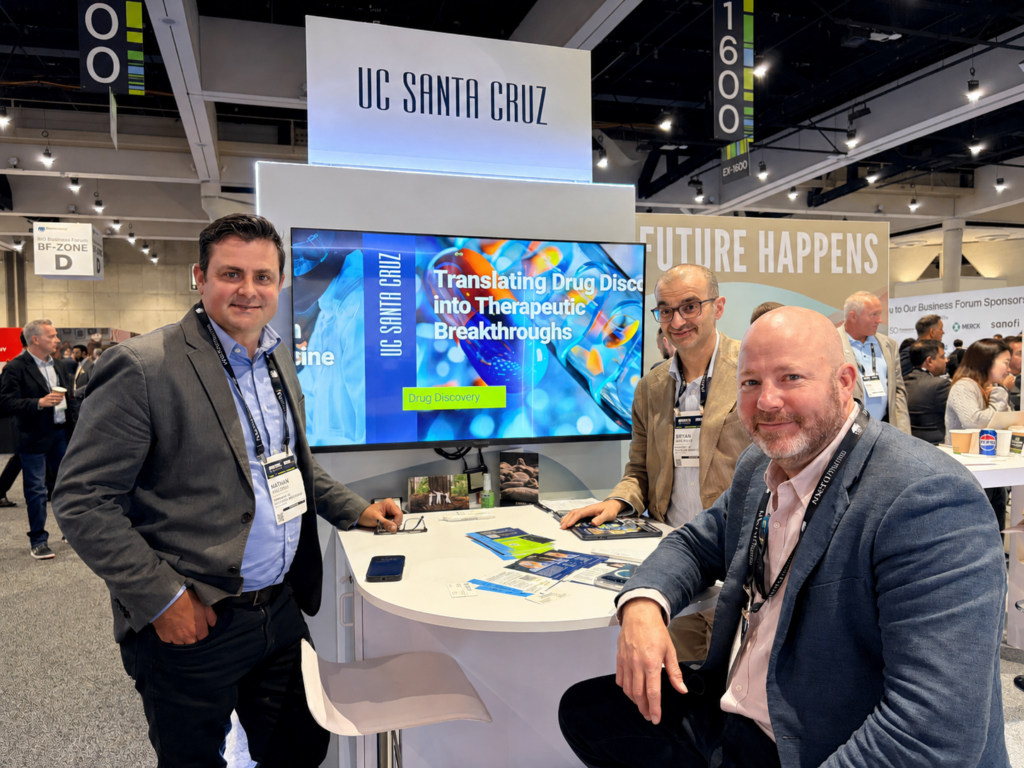
Campus leaders are now carrying that momentum forward with the RNA Futures Meeting, being held at UC Santa Cruz from August 18 to 21. The scale of this event will also be a first for campus, bringing together leaders from academia and industry to discuss the next generation of discoveries in RNA biology and how they can be translated into new therapies and technologies.
“Rather than simply presenting completed work, the goal is to foster the conversations and collaborations that define where the field is headed,” said Jeremy Sanford, professor and chair of the Department of Molecular, Cell, & Developmental Biology at UC Santa Cruz. He also serves as co-director of the UCSC RNA Center, along with professors Michael Stone and Susan Carpenter, co-organizers for the inaugural international conference.
Preparing students for industry
“One thing that stood out to me at BIO was the number of successful UCSC alumni working throughout the biotechnology sector. Whether they earned undergraduate or doctoral degrees here, they are making important contributions across the industry,” Sanford said. “That reflects the strength of our research enterprise and our longstanding emphasis on giving students meaningful research experiences.”
A perfect example of this is alumnus Cameron Pye (Ph.D. ’17, chemistry and biochemistry), co-founder of the biotech startup Unnatural Products, which develops drugs that use a unique type of molecule called a macrocycle. He and fellow alum Joshua Schwochert (Ph.D. ’17, chemistry and biochemistry) founded and run their company in Santa Cruz to create medicines that cross previously impenetrable barriers—allowing treatments to reach “undruggable” parts of the body.
Riding the momentum of major partnerships with two pharmaceutical giants announced within the last year, Pye, CEO of Unnatural Products, was at the BIO convention. Another alum at the event was Rachel Bomberger (Crown ’11, ecology and evolutionary biology), a member of Texas State University’s Division of Research.
Bomberger said her passion for science blossomed at UC Santa Cruz, where she had multiple opportunities to conduct undergraduate research, including a field trip to the Big Creek Natural Reserve in Big Sur as part of a plant ecology course taught by Professor Ingrid Parker. For Parker’s excellence in plant research, she has been recognized with Ecological Society of America and California Academy of Sciences fellowships, along with awards from numerous institutions.
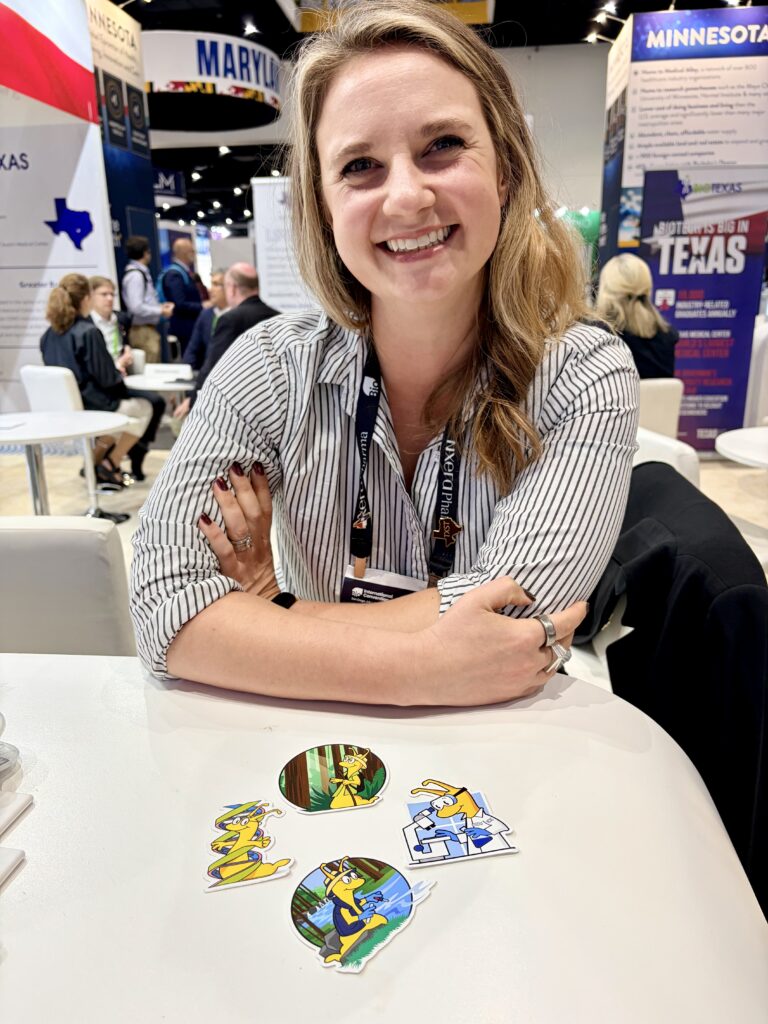
After Bomberger graduated from UC Santa Cruz, she earned an M.S. in plant pathology from Oregon State University, and for several years, taught and conducted graduate research at the university. After that, she spent a decade working as a plant diagnostician for the Nevada Department of Agriculture and then Washington State University, before moving to the Lone Star State.
“UC Santa Cruz’s campus provided the catalyst—and ecosystem—for my interest in plant sciences that grew into my first career. The research experiences and plant-science classes provided foundational knowledge, but more importantly, imbued me with a sense of identity as a budding scientist,” Bomberger said. “While I’ve transplanted myself across the nation, UCSC is where my talents were first cultivated.”
Forging the future of RNA research
From a campus perspective, Sanford said, the RNA Futures Meeting will showcase UC Santa Cruz as a place where fundamental discoveries, interdisciplinary collaboration, and innovation intersect. Organizers also seek to highlight the growing impact of the RNA Center and reinforce the campus’s leadership in RNA biology discoveries.
The potential impact of the science to be discussed extends well beyond the lab. RNA research is transforming our understanding of how genes are regulated and how cells function, leading to entirely new approaches for treating diseases that have historically been difficult to address—including cancer, neurodegenerative diseases, rare genetic disorders, and infectious diseases.
According to Sanford, the rapid development of mRNA vaccines has demonstrated what is possible when decades of fundamental RNA research reach clinical application. Today’s advances in RNA therapeutics, RNA-targeted medicines, and precision-gene regulation have the potential to do the same for many other diseases.
But what excites him most is that the meeting isn’t only about celebrating scientific breakthroughs. It’s about creating an environment where students, trainees, academic scientists, and biotech leaders can exchange ideas, build collaborations, and inspire the next generation of discoveries. Those interactions are often where transformative science begins.
“In many ways, BIO shows us where biotechnology is today. RNA Futures is about bringing together the people who are defining where biotechnology will be tomorrow,” Sanford said. “We’re proud that UC Santa Cruz can convene those conversations and give our students a front-row seat to the future of RNA science.”