Climate & Sustainability
Partnership with Fujitsu enables long-term impact forecasting of climate risks
Ashesh Chattopadhyay and Fujitsu Research are developing actionable AI-based climate models that reduce resource-guzzling computation time from months to minutes
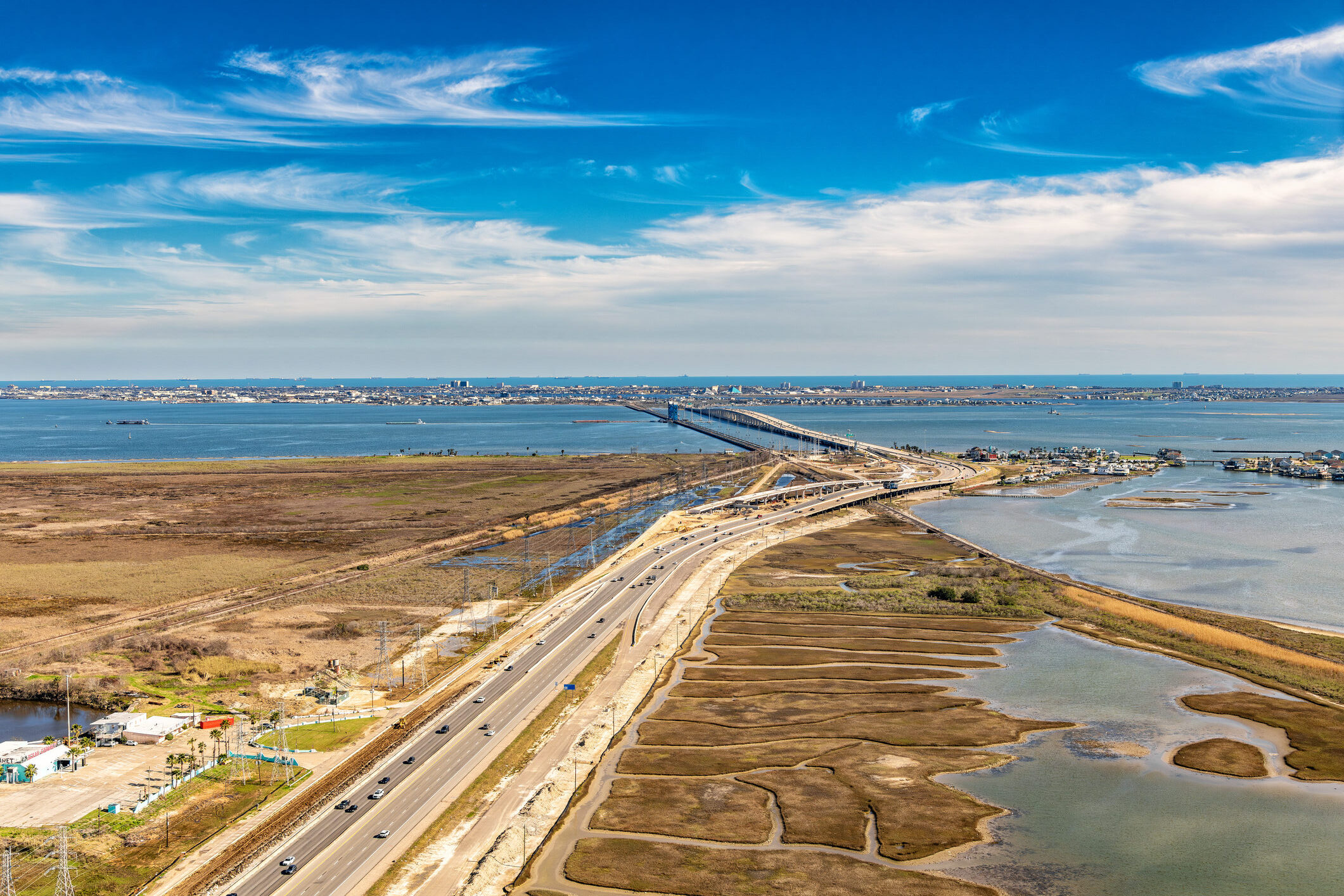
Galveston, Texas, is a port city and barrier island that is prone to heat and flooding, which could endanger infrastructure like the Galveston Causeway, seen here.
Art Wager/ Getty Images
Press Contact
The city of Galveston, Texas, is a barrier island on the Gulf Coast that’s a lively tourist hub and a major port for commerce shipping. It’s also particularly susceptible to high heat and flooding, and projecting future risks due to climate changes can help policymakers and others take action to protect people and infrastructure.
At the University of California, Santa Cruz, Assistant Professor of Applied Mathematics Ashesh Chattopadhyay is developing tools for actionable risk metrics in partnership with Fujitsu Research, a global leader in IT services. This collaboration enables Chattopadhyay to build user-oriented, energy-efficient AI models for climate predictions and solutions that analyze vulnerable regions like Galveston. It also provides highly relevant internships for his Ph.D. students, and now, an unrestricted research gift to his lab.
“This is a collaboration where our research is driven by impact and operational use, as opposed to just unraveling scientific understanding of certain difficult processes in the world like the climate system,” Chattopadhyay said. “We choose problems that are relevant today and that will have societal impact.”
Risk and impact
Chattopadhyay’s research at the Baskin School of Engineering focuses on building accurate AI climate emulators that project changes to large-scale climate systems five to 10 years into the future, and can be narrowed, or “downscaled,” to study the specific dynamics of small regions. Compared to traditional, physics-based climate models, the AI-based models are orders of magnitude faster and provide energy-saving benefits—reducing resource-guzzling computation time from months to minutes.
“It’s a climate problem we’re looking at. We ask: as the world changes, how does my risk change? As opposed to: in this current world, what is my risk in the next 48 hours?” Chattopadhyay said.
Together with Fujitsu, Chattopadhyay develops these efficient AI models that address real-world climate forecasting and engineering needs. He began collaborating with Fujitsu in 2023 on a project to better model ocean surface dynamics, and this initial work has been incorporated into the company’s ongoing research and development efforts. Now, his lab is working with the company’s Space Data Frontiers research group and researchers at Lehigh University to develop a new tool for understanding climate risks guided by industry needs.
“Working closely with Ashesh’s group lets Fujitsu move quickly at the frontier of climate and ocean AI research—building models that are not only fast, but physically consistent and stable enough to trust in real-world decisions,” said Subhashis Hazarika, principal researcher at Fujitsu Research of America. “That combination of scientific rigor and operational relevance is exactly what lets us take this work from research into tools our industry partners can rely on.”
Called DeepRisk, this AI tool creates projections of future changes to the climate. Users can choose any area in the continental U.S. or Canada to focus on, specifying down to areas as small as 3-by-3 kilometers. The scientific insights on changes to Earth system dynamics are translated to actionable risk metrics for impacts on infrastructure like railroads, bridges, or individual roads, which can be crucial for strategic and even life-saving decisionmaking.
For example, in Galveston, which serves as the pilot project for DeepRisk, projections for increased rainfall over the region could be translated into insights on the downtime of a network of highways due to flooding, and what kind of actions could be taken to reduce the risks of these downtimes.
“DeepRisk is a tool that starts from fundamental science and translates that into actionable insights for industries such as insurance, policymakers, and other decision makers that might not care necessarily about the science, but care about the impact of the science,” Chattopadhyay said. “It is lab to market—something that an end user can directly interact with.”
Close-knit collaboration
For Chattopadhyay, what began as a single project has evolved into a broader partnership—and now, an unrestricted research gift to support his lab’s ongoing work.
He notes that a close-knit community has developed between his lab and the Fujitsu Research team. This close relationship creates valuable career opportunities for his students, while providing the crucial scientific credibility that has helped attract awards from the Sloan Foundation and other private funders.
So far, three Ph.D. students in Chattopadhyay’s group—Leonard Lupin-Jimenez, Moein Darman, and Niloofar Asefi—have been year-long residents with Fujitsu, which has a Santa Clara location near the UC Santa Cruz Silicon Valley campus, and received ongoing support from the company. This experience provides valuable career development, and has led to additional opportunities for them in research and industry.
“It definitely helps them branch out into tech companies in Silicon Valley that are focused on the physical sciences and engineering, not just LLM companies,” Chattopadhyay said.