Earth & Space
International body honors UC Santa Cruz physicist with Frontiers of Science Award
Assistant Professor Edgar Shaghoulian was honored by the International Congress of Basic Science at an August 9 ceremony in Beijing with a Frontiers of Science Award in the category of formal quantum field theory
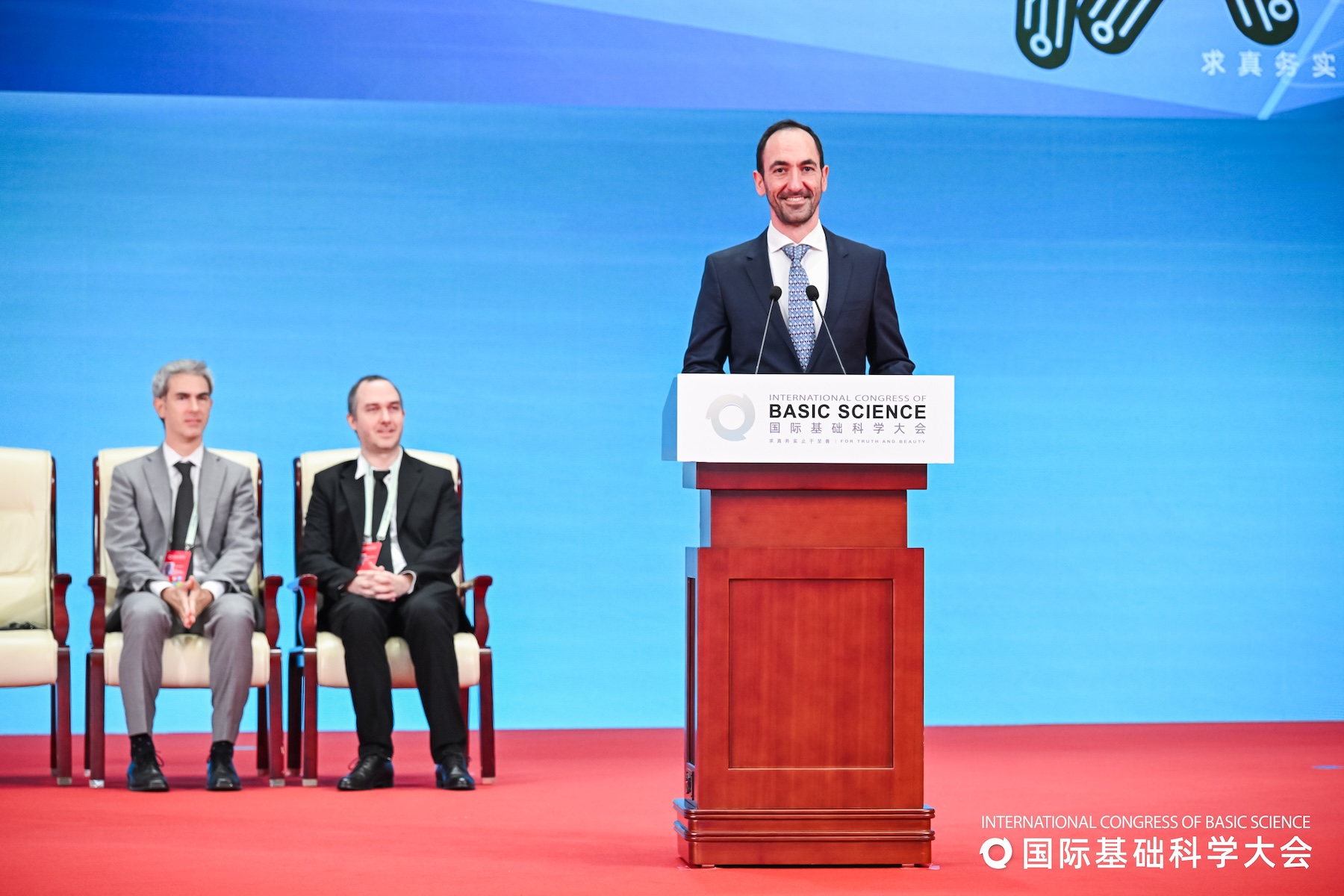
Shaghoulian was honored for his 2020 journal article addressing the “black hole information paradox,” a fundamental puzzle in theoretical physics.
Source: ICBS
Press Contact
UC Santa Cruz physicist Edgar Shaghoulian was honored by the International Congress of Basic Science (ICBS) at an August 9 ceremony in Beijing with a Frontiers of Science Award in the category of formal quantum field theory. The assistant professor was awarded for his 2020 paper in the Journal of High Energy Physics, “Replica wormholes and the entropy of Hawking radiation.”
Now in its third year, ICBS presents the Frontiers of Science Award “to encourage young scholars to look to the frontiers of basic science, set goals to obtain breakthrough results as early as possible, and contribute wisdom and energy to humankind’s study of the mysteries of the natural world.” For this year’s selection, scientific works in both basic and applied research were chosen in 40 areas of three basic fields: mathematics, physics, and information sciences and engineering.
For this award, ICBS invites researchers worldwide to nominate candidates who a panel of renowned experts reviews and then creates a shortlist for each research area. ICBS then empanels an international committee to decide the winners.
Shaghoulian’s paper addresses the “black hole information paradox,” a fundamental puzzle in theoretical physics that asks what happens to physical information when material falls into a black hole. According to quantum mechanics, information can never be destroyed, but Stephen Hawking’s classic calculations suggested that Hawking radiation emitted by a black hole is completely random, meaning all information about what created the black hole is permanently lost when it evaporates.
The authors resolved this discrepancy by discovering “replica wormholes,” new gravitational pathways that connect multiple parallel copies of the black-hole spacetime. Accounting for these wormholes recalculates the fine-grained randomness of Hawking radiation and demonstrates that it follows an expected process required by quantum mechanics: the randomness rises initially, peaks, and then drops back down to zero as the black hole fully evaporates.
This, then, preserves physical information and confirms that black-hole evaporation is a unitary, information-preserving process, according to the paper. “You only get a couple of papers like this in a career,” Shaghoulian said. “I’m just glad mine got to merge two of my childhood curiosities: wormholes and black holes.”
While relatively new, ICBS is making strides in fostering scientific dialogue and cooperation, drawing notable attendees like Nobel laureate David Gross and prominent researchers from prestigious institutions in the United States and abroad. ICBS is funded and hosted by the Beijing City government and several Chinese governmental bodies, including its national Ministry of Science and Technology, the China Association for Science and Technology, and the Beijing Institute of Mathematical Sciences and Application.