Earth & Space
A student’s trajectory from Tanzania and transformation into a scientist
On its 150th anniversary, Lick Observatory draws on its legacy of pioneering research to continue producing the next generation of scientific instruments, techniques, and astronomers
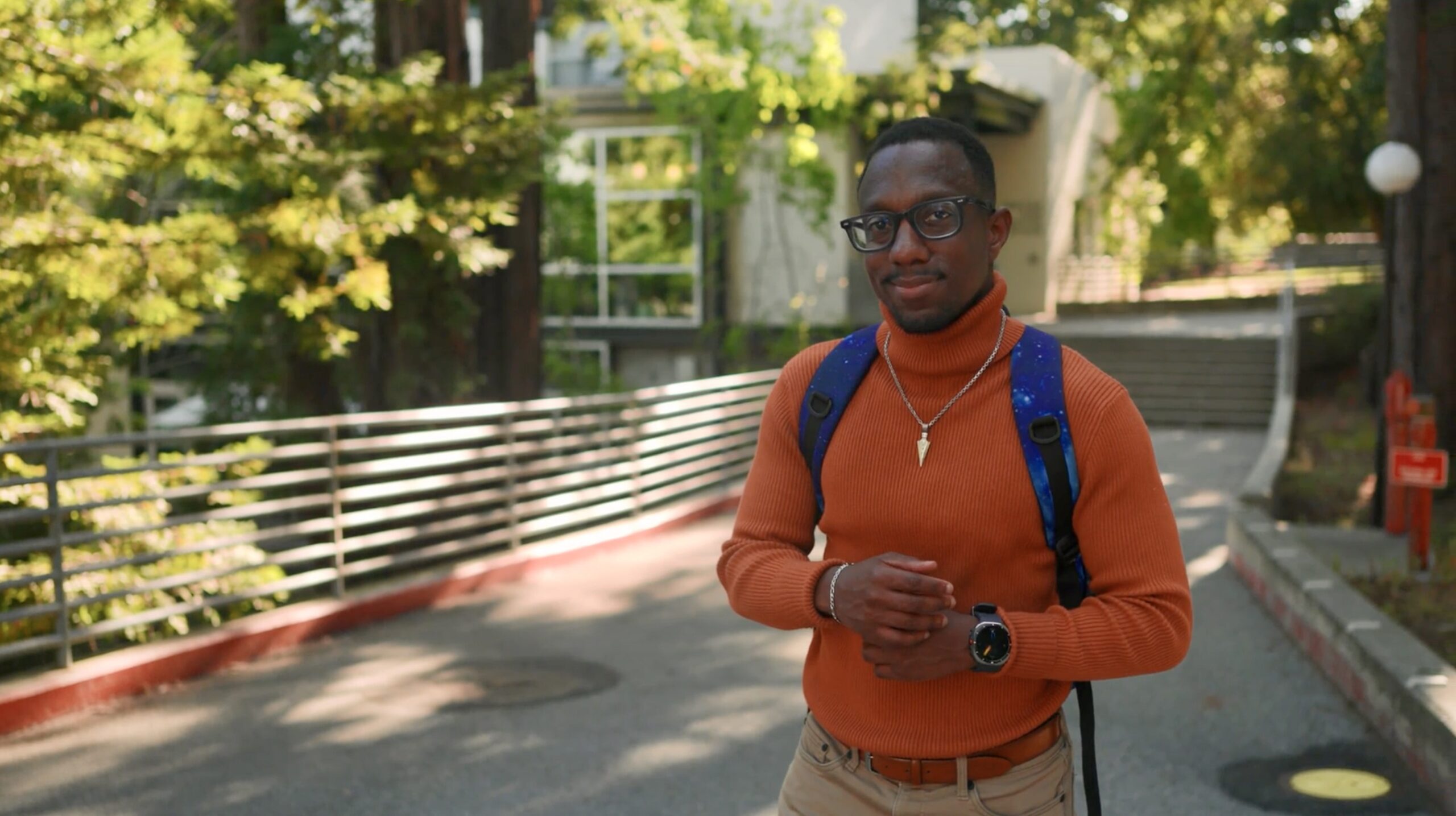
Ph.D. student Lordrick Kahinga’s journey to Lick Observatory began by watching a YouTube video.
Press Contact
For Lordrick Kahinga, Lick Observatory was where he went from seeing himself as someone studying science to feeling like an actual scientist. Originally from Tanzania, Kahinga said careers in science are much more limited due to the lack of research infrastructure, especially in astronomy and astrophysics.
This only made Kahinga gravitate more toward science outside of class. He majored in physics as an undergraduate, and after watching random astronomy videos on YouTube one day, he came upon a lecture by a professor at the University of California, Santa Cruz, that stoked his curiosity about a cosmic phenomenon known as Lyman-alpha. He reached out to the professor, met with him over Zoom, and not only got the full scientific explanation, but managed to convey his exceptional potential and passion.
That professor, J. Xavier Prochaska, invited Kahinga to come to campus to earn a Ph.D. UC Santa Cruz, which runs Lick Observatory, was the perfect place to provide that transformative moment when an aspiring astronomer moves on from archival data and documents, and looks through a working telescope for the first time and realizes that becoming a scientist is possible.
Today, Kahinga is entering his fourth year as an astronomy and astrophysics Ph.D. student, researching fast radio bursts, which are sudden flashes of radio waves coming from random parts of the sky. Each one is on only for a few milliseconds, but they are extraordinarily bright: In those few milliseconds, some can put out more energy than our sun does in an entire year.
“At Lick Observatory, I found confidence in myself as an astronomer,” said Kahinga. “It’s a place where undergraduates, graduate students, professional astronomers, teachers, and mentors of the public can all encounter astronomy directly.”
As the University of California marks Lick’s 150th anniversary this month, Kahinga’s story underscores why the landmark observatory atop Mount Hamilton east of San Jose remains one of the state’s most valuable scientific facilities. Lick provides unparalleled, hands-on training that no classroom or remote facility can replicate.
Graduate students like Kahinga operate world-class instruments, design and test new technologies, and conduct independent research under real observing conditions—experiences that have launched generations of leading astronomers and astrophysicists.
With a total of nine telescopes in operation today, Lick sits on approximately 3,000 acres originally deeded to UC in 1876 by real-estate entrepreneur James Lick, reportedly the richest Californian at the time. The land was transferred through an Act of Congress, and Lick, seeking to cement his legacy, bequeathed $700,000—$1.2 billion by today’s standards—to build the world’s largest telescope.
It was the first permanently staffed mountain-top observatory, and the 36-inch Great Refractor was the world’s largest telescope of its kind and continued to be a premier research telescope for half a century. One of the earliest innovative technologies made and tested at Lick was Albert Michelson’s use of interferometry to measure the size of Jupiter’s moons in 1891, which led to him winning a Nobel Prize in 1907.
Ever since then, Lick has been at the frontier of astronomical discovery—from the first systematic surveys of the solar system to the detection of exoplanets, the discovery of the accelerating expansion of the universe, and the invention of adaptive optics that transformed ground-based astronomy worldwide. Lick’s legacy is California’s legacy: bold investment in science that changed our understanding of the cosmos.
A legacy of innovation
In the 1980s and ’90s, Lick became a critical R&D engine, testing tools and paradigms that every major observatory now uses. UC Santa Cruz astronomers like Lloyd Robinson and Joe Miller pioneered the advanced digital sensors that replaced film, paving the way for the cameras on the Hubble and James Webb space telescopes.
To sharpen ground-based vision, Claire Max, Donald Gavel, and Scot Olivier from Lawrence Livermore National Laboratory tested the first laser guide star adaptive optics, a system now standard on Keck and the Very Large Telescope observatories. Lick was also the epicenter of the exoplanet revolution: Steven Vogt and Paul Butler used the Hamilton spectrograph to confirm the existence of worlds beyond our solar system.
Furthermore, Jerry Nelson used Lick as the testing ground for the segmented mirror technology that powers the Keck telescopes and the James Webb Space Telescope. From Joseph Miller and Robert Antonucci’s foundational work on black holes to the autonomous robotic surveys pioneered by Alex Filippenko, these innovations underscore that Lick is far more than a historical landmark. It remains an essential foundation of today’s global astronomical infrastructure.
“Lick is the foundation of the University of California’s whole astronomy system,” said UC Observatories Director Bruce Macintosh. “From the generations of students who learned to think of themselves as scientists here, to the new technology we develop and keep developing, it helps build the future of science in our state.”
Looking ahead
Beyond the legacy of pioneering research, Lick is an epicenter of ongoing innovation and the epitome of resilience. Less than two months after winds exceeding 100 miles per hour violently dislodged the multi-ton shutter from the refractor dome, a temporary cover was completed in early February. Even without the historic Great Refractor in operation, mountain staff are still hosting visitors and running night-time programs for people to see the stars.
Planning for permanent dome repairs and other restoration work continues, as do cutting-edge research and development. With a $4 million gift from the Kavli Foundation and individual philanthropy, UC Santa Cruz astrophysicist Kevin Bundy and UCLA astrophysicist Pradip Gatkine are developing a next-generation instrument for detecting and studying the formation of planets around nearby stars.
This first-ever, facility-grade astrophotonic instrument will be deployed at Lick’s Shane 3-meter Telescope. “Lick is only one of two telescopes on Earth where cutting-edge astrophotonic technology is regularly tested,” said Bundy, an associate professor of astronomy and astrophysics. He and other scientists at Lick are pioneering new observing techniques, while powering discoveries at Keck, the new Vera C. Rubin Observatory, and beyond.
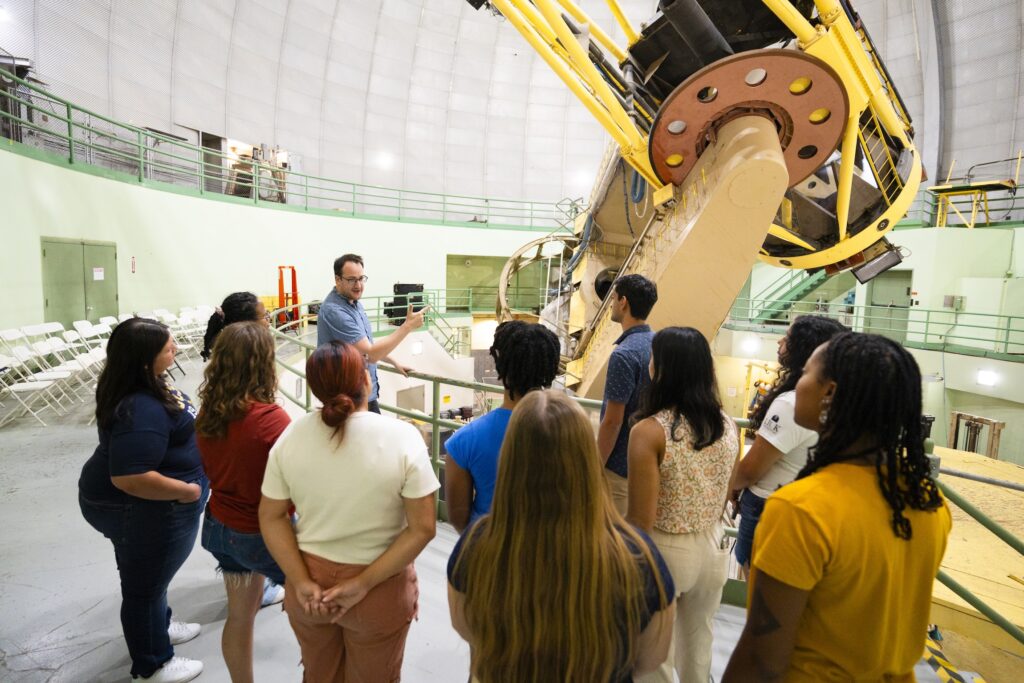
In addition, with support from the Gordon and Betty Moore Foundation, UC Observatories operates the Scientific Teaching through Astronomy Research (STARs) program. STARs brings students from California State University and community colleges throughout the Bay Area to Lick Observatory to inspire them in their STEM journey and give them the same sort of transformational moments that Kahinga and hundreds of other UC students have.
For Kahinga, Lick is where he has learned to make critical decisions, solve problems under pressure, and take responsibility for an observing program. He says he learns something new every time he goes to the observatory—whether from staff, other scientists, or even the students he sometimes brings with him. In contrast to conducting remote observations like those he first did back in Tanzania, the observations he now does at Lick make astronomy feel physical and real.
“Lick Observatory is not only just for research and education, but it’s also a very good testing ground for instruments for other telescopes,” Kahinga said. “Not only that, it trains a lot of instrumentation scientists. So it’s really important for Lick Observatory to continue on with its work for 150 more years.”
After a brief pause, he remarked, “It would be quite a shame to science, to instrumentation, to students and the public alike if Lick Observatory was no more.”