Health
UC Santa Cruz is building better detection for rare form of cancer
New five-year NIH-funded project aims to transform the detection of synovial sarcoma using advanced single-molecule analysis

Tim Vorenkamp, diagnosed with Stage 3 synovial sarcoma just as he entered his teen years, died in 2016 at age 18. His story continues to inspire this project.
Source: Petra and Pieter Vorenkamp
Press Contact
Key takeaways
- An interdisciplinary research team has been awarded $3.6 million by the National Institutes of Health to develop a new, highly sensitive diagnostic tool for synovial sarcoma, a rare and aggressive cancer that primarily affects young adults.
- The project addresses a critical diagnostic gap by using advanced “nanopore” technology, which can detect minute cancer biomarkers in blood samples more effectively than existing methods.
- The researchers are creating a platform that will improve early cancer detection and could eventually be applied to other diseases, such as neurodegenerative conditions.
- This initiative unites expertise in clinical genetics, optofluidics, and semiconductor manufacturing from UC Santa Cruz and Brigham Young University to transition this technology into clinical use.
An interdisciplinary team of researchers at the University of California, Santa Cruz, has been awarded nearly $3.6 million over five years by the National Institutes of Health (NIH) to develop a breakthrough diagnostic device for synovial sarcoma, a rare and aggressive cancer that predominantly strikes adolescents and young adults.
The project, led by principal investigator Olena Vaske, associate professor of molecular, cell, and developmental biology, and co-investigator Holger Schmidt, distinguished professor of electrical and computer engineering, aims to create a highly sensitive nanopore assay capable of detecting minute RNA and protein biomarkers. Vaske and Schmidt are associate members of the UC Santa Cruz Genomics Institute, and by studying how these biomarkers drive tumor progression, they hope to pave the way for early detection and new treatments for this disease—as well as for other cancers, autoimmune, and neurodegenerative conditions.
“This project was inspired by our friends and long-term supporters Pieter and Petra Vorenkamp at Live For Others Foundation. Pieter and Petra, who lost their son Tim to synovial sarcoma, shared their hope to one day have a sensitive, accurate, non-invasive diagnostics for synovial sarcoma and other rare diseases,” Vaske said. “We hope that this grant will take us one step closer to that reality.”
The synovial sarcoma work in Vaske’s lab was started by 2025 Ph.D. graduate Yvonne Vasquez, and is now led by Ph.D. student Maryke Grobler.
The challenge: A hidden threat to young adults
Synovial sarcoma is a dangerous soft-tissue cancer with approximately 800 to 1,000 new cases diagnosed annually in the United States. It is particularly devastating because it frequently affects a younger demographic—adolescents and young adults—and often goes undetected until it has reached an advanced stage. For patients whose cancer has already spread, or metastasized, the survival rate is a staggering 10%.
Current diagnostic methods are substantially deficient. While a specific gene fusion (SS18-SSX) is a known “hallmark” of the disease, existing liquid biopsies—tests that look for cancer markers in blood—often fail to detect it in patients who do not yet have widespread metastatic disease. These methods, such as PCR and standard sequencing, rely on amplifying genetic material, which can be highly fragmented and difficult to “catch” in a patient’s blood sample.
Consequently, diagnostic delays are common, leading to poor life outcomes for those affected.
The solution: TACRE and nanopore technology
To overcome these barriers, the research team is developing a solution based on the “Trapping-Assisted Capture Rate Enhancement” (TACRE) principle recently developed by Schmidt’s lab. In simple terms, TACRE works by directly and efficiently counting individual molecular disease biomarkers. Instead of waiting for rare cancer molecules to randomly bump into a sensor, the system uses tiny functionalized microbeads to specifically grab the target RNA or protein biomarkers from a sample. These beads are then physically trapped directly next to a sensor, ensuring that when the biomarkers are released, they are immediately caught and counted.
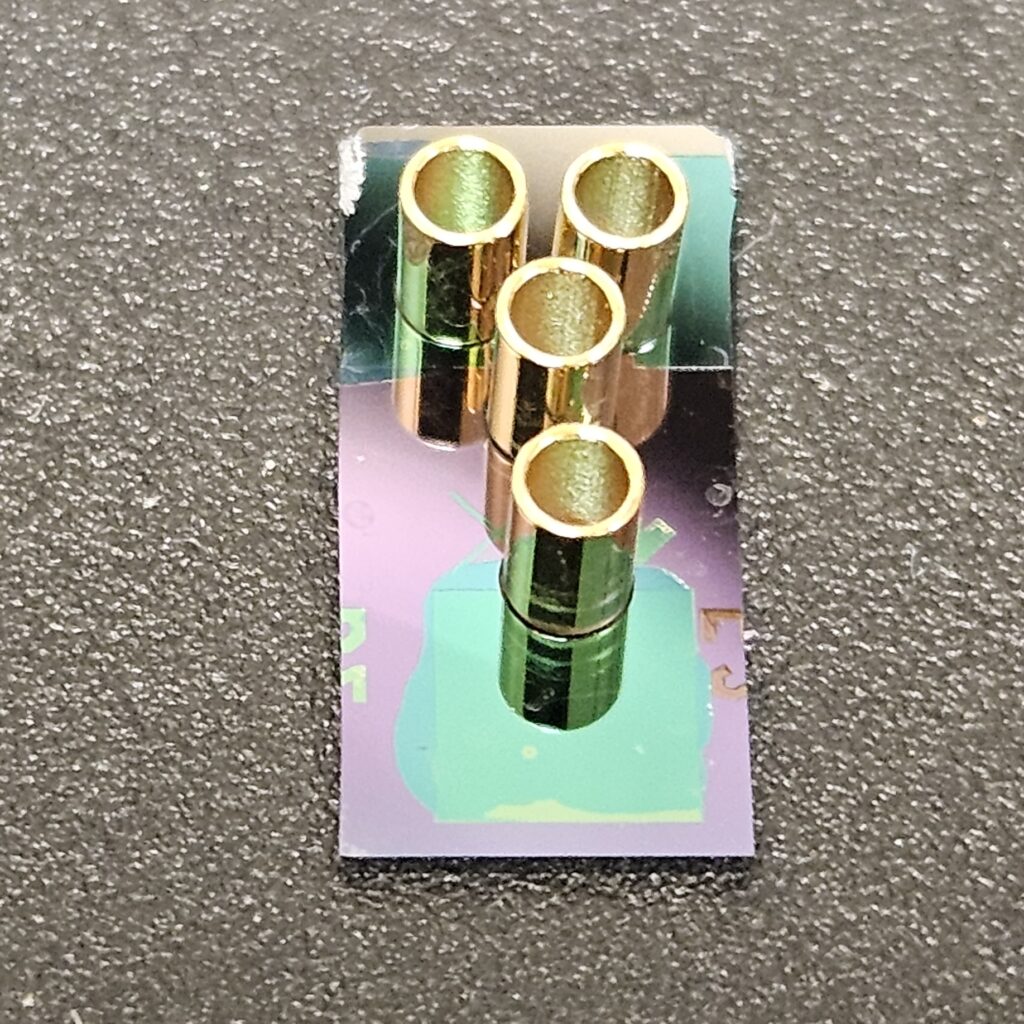
The “sensor” at the heart of this device is nanopore technology. A nanopore is an incredibly small opening—just nanometers wide—in a synthetic membrane. As individual molecules pass through this tiny hole, they cause measurable changes in an electrical current. By analyzing these changes, researchers can count single molecules of cancer-driven proteins or RNA without the need for complex labels or the risky step of chemical amplification.
Nanopore technology was originally developed at UC Santa Cruz as a new DNA sequencing technology, Schmidt explained. “Over the past few years, we have invented new ways of using nanopores inside miniaturized labs on a chip to enable ultrasensitive detection of both DNA/RNA and proteins,” he said. “This technology can be applied to many areas in medical diagnostics, including cancer, infectious diseases, and neurodegenerative diseases.”
An interdisciplinary powerhouse
This project leverages the unique strengths of three primary investigators and their respective institutions. In addition to founding the Treehouse Childhood Cancer Initiative at UC Santa Cruz, Vaske is a board-certified clinical molecular geneticist. Her lab specializes in translating advanced genomic data into clinical tools. She will oversee the study of how synovial sarcoma cells communicate and will lead the effort to bring this technology into clinical use through the Colligan Clinical Diagnostic Laboratory.
A pioneer in optofluidics, Schmidt directs the W.M. Keck Nanofabrication Facility at UC Santa Cruz. His lab focuses on integrating single-molecule analysis onto compact, chip-based systems. Schmidt will be responsible for the design, fabrication, and testing of the integrated nanopore chips and the underlying electrical detection assays.

Aaron Hawkins, a professor of electrical and computer engineering, directs Brigham Young University’s Integrated Microfabrication Laboratory. His group possesses world-class expertise in semiconductor manufacturing and will create the specialized low-stress membranes required for these advanced microfluidic chips.
“We have a fantastic team with fantastic nanotechnology,” Hawkins said. “We have a great shot at transforming how rare cancers are monitored and treated. We hope to also make breakthroughs in understanding how cancer starts and progresses.”
Your support for Professor Vaske’s work will enable her team to deliver on the promise of developing precision treatments so that all children with cancer can be cured.
Learn more about how we’re driving an integrated approach to health and well-being through our Inspiring Change fundraising campaign.