Climate & Sustainability
UC Santa Cruz researchers launch real-time study on kelp resilience as a super El Niño unfolds
The sweltering seas expected this winter could threaten California’s kelp forests. UC Santa Cruz researchers are mobilizing to track the impacts and seek public support to sustain student engagement in the research.
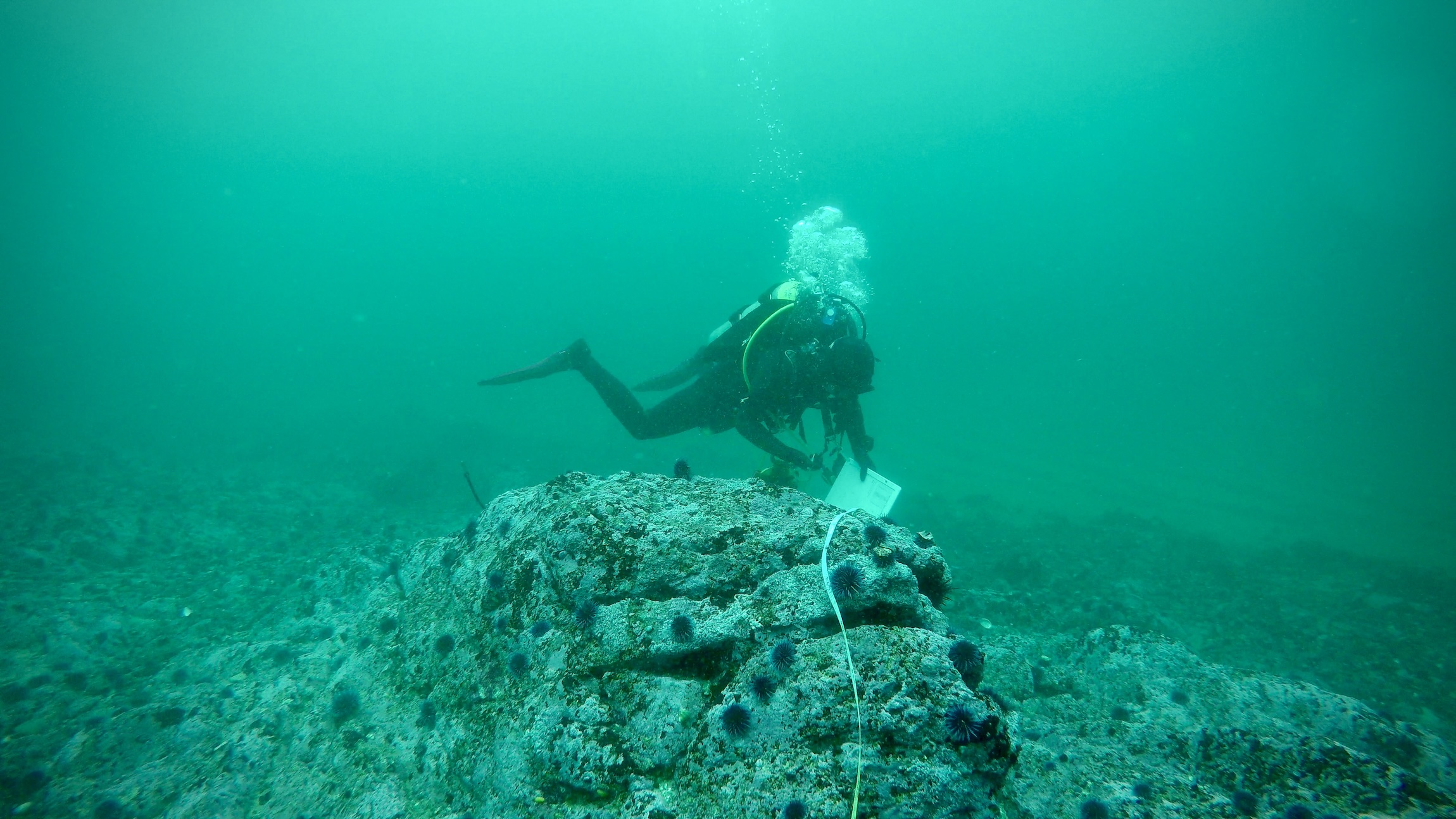
A dense kelp forest once thrived on this site in Monterey, Calif. But it’s now barren because of purple sea urchins that proliferated after an intense marine heatwave about a decade ago.
Credit: Nearshore Ecology Research Group, UC Santa Cruz
Press Contact
Key takeaways
- A team of UC Santa Cruz students and their professor are seizing a rare and fleeting window to study how giant kelp forests withstand severe ocean warming.
- This real-time study aims to deliver actionable insights to help prevent the collapse of coastal marine ecosystems that are still recovering from a major marine heatwave that occurred 10 years ago.
- Community members can sustain the research with donations that would support student training.
A rapid-response team of students and their professor at the University of California, Santa Cruz, are doing real-time research to measure how the region’s iconic giant kelp forests respond to ocean warming expected during a powerful “super El Niño” that is set to surge across the Pacific.
The Nearshore Ecology Research Group, led by UC Santa Cruz professor Joshua Smith, is treating this forecasted extreme climate event as a natural opportunity. The team is studying the effects of acute ocean warming on these undersea forests, which are still recovering from widespread losses that occurred during a marine heatwave over a decade ago.
“We now have a rare, time-sensitive opportunity to understand, and potentially mitigate, another large-scale ecosystem shift as it unfolds,” said Smith, an assistant professor of ecology and evolutionary biology. “This project will deliver actionable science in near to real time”
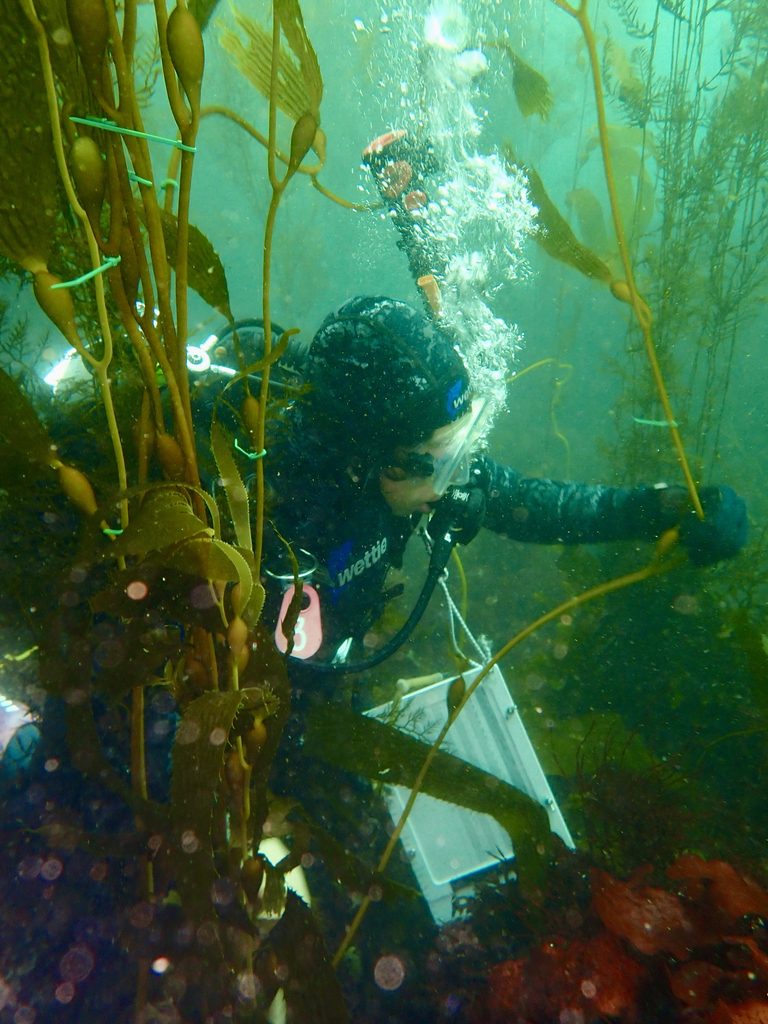
Smith and students from his lab are diving throughout Monterey Bay on a weekly basis. “Seeing the sheer volume of life in kelp forests, and the stark contrast with urchin barrens, completely changed my understanding of the scale and complexity of these ecosystems,” said UC Santa Cruz fourth-year undergraduate Pacey Jones. “It made me feel like I was contributing as a scientist, not just learning about science in a classroom.”
Beyond the shoreline
El Niño events are often associated with increased precipitation that leads to flooding and coastal erosion during powerful storms. However, El Niño actually begins in the ocean, and its effects extend beneath the surface. Warm water and reduced nutrient availability can slow kelp growth, diminish productivity, and alter the food webs that depend on kelp.
This winter’s potentially historic El Niño is also raising concerns that marine wildlife and ecosystems already struggling to cope with the effects of warming oceans will be more vulnerable.
From dead humpback whales washing ashore to starving seabirds on beaches, these recent incidents and others in the region have been linked to a major marine heatwave in the western Pacific that developed in late 2025. “This is a fleeting opportunity to study ecosystem shifts in real time,” Smith explained. “The window to act is short, and the insights gained will directly inform how we respond to climate-driven change along the California coast and beyond.”
An ecosystem worth protecting
The stakes could not be higher. Giant kelp, the foundation of coastal ecosystems from Mexico to Alaska and across temperate regions around the globe, is one of the most productive organisms on Earth. These underwater forests act as nurseries for thousands of marine species, including commercially important ones like abalone and rockfish. Beyond their ecological value, kelp forests contribute an estimated $500 billion annually to the global economy, serving as a key ingredient in products ranging from toothpaste and pharmaceuticals to salad dressings. But kelp forests depend on a delicate balance.
Under typical conditions, sea urchins remain sheltered in cracks and crevices, feeding on pieces of kelp that drift along the seafloor. When warming reduces kelp production, and the supply of drifting food dwindles, urchins may emerge from shelter and begin grazing living kelp, accelerating the transition from kelp forest to sea urchin barren. That’s what happened from 2014 to 2016, when the last marine heatwave in California triggered widespread kelp-forest collapse and a massive outbreak of hungry sea urchins.
“We’re now asking whether warm water reduces the export of drifting algae that normally keeps sea urchins fed and tucked away in cracks and crevices,” Smith said. “If that food supply dwindles, will the urchins emerge and begin grazing living kelp, setting off a cascade?”
Supporting this study
This rapid research is already underway with support from the California Ocean Protection Council and the Seaver Institute, along with project partners at the Monterey Bay National Marine Sanctuary. That early support has allowed the team to mobilize quickly as El Niño conditions strengthened.
Additional donations will allow the team to sustain this research through the duration of El Niño and follow the ecological responses into the period when unusually warm conditions begin to subside. Those continued observations are essential for determining not only how kelp forests respond during the extreme event, but whether they persist, cross ecological thresholds, or begin to recover afterward.
Individual contributions will support scientific diving, field sampling, equipment and data collection, while also providing hands-on research training for one UC Santa Cruz graduate student and three undergraduates in scientific diving, ecological monitoring, open-data science, and coastal stewardship.
More broadly, this research aims to generate a mechanistic understanding of how climate extremes alter key interactions, in order to help predict and manage ecosystem collapse in a warming ocean. Such insights are essential for protecting coastal ecosystems that support fisheries, recreation, biodiversity, and culturally important species like sea otters, sea stars, and abalone.
“Knowing that this event cannot be recreated later makes collecting these data feel especially meaningful,” said Xochitl Churchill, a CAMINO student researcher on Smith’s team. “It is motivating to know that my work as a student can contribute to our understanding of how climate change affects local kelp forests, while helping me build skills I will carry throughout my academic career.”
Anyone seeking to support the urgent work of Smith’s dedicated field team can make a donation to the Nearshore Ecology Research Group Fund.