Climate & Sustainability
Unveiling the unevenness of global warming: Regional accelerations, key temperature shifts, and extreme events
As record-breaking global temperatures and extreme weather events spark intense debate over global warming speed-up, a new study led by UC Santa Cruz reveals how warming is accelerating differently across distinct regions.
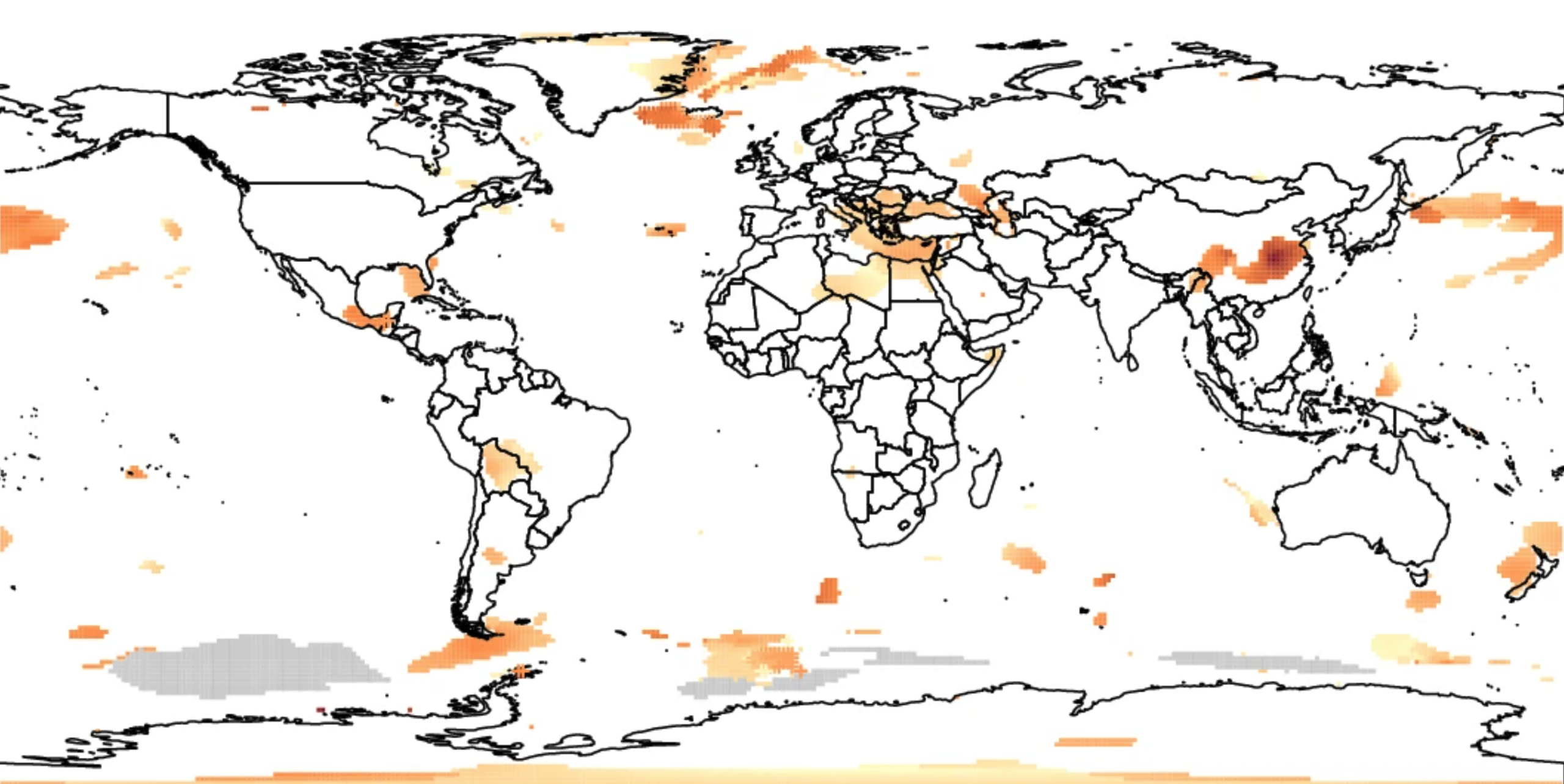
This map from the new paper shows regions that exhibit changes in the rate of warming, highlighted in colors. Mid latitudes in the Northern Hemisphere are where changes are more prominent. Darker red indicates the most pronounced changes and is concentrated in southeast China.
Press Contact
Key takeaways
- This study found that global warming acceleration is not uniform, but concentrated in distinct regional waves across the Northern Hemisphere’s mid-latitudes, such as southeast China and the Gulf of Mexico.
- By analyzing surface-temperature datasets from 1970 to 2024, researchers found that localized warming speed-ups emerged between the 1980s and 2010s.
- Accelerations in mean warming rates shift the baseline for extreme events, increasing the frequency and intensity of regional heatwaves.
- Pinpointing where and when these accelerations have occurred provides essential context for climate-adaptation efforts and regional climate-risk assessments.
New research from the University of California, Santa Cruz, in collaboration with other institutions highlights the fragmented and staggered timing of warming increases across the planet, providing a nuanced perspective on the debate over global-warming acceleration.
The new study is published in Nature Communications and authored by researchers at UC Santa Cruz, Clemson University, and the NOAA Geophysical Fluid Dynamics Laboratory. The research team analyzed multiple surface temperature observational datasets from 1970 to 2024, and used advanced statistical modeling, to identify coherent spatial and temporal patterns in warming-rates shifts.
A key finding: The most recent accelerations are most prominent in regions of the Northern Hemisphere’s mid-latitudes, such as southeast China and the Gulf of Mexico.
“What we wanted to do is provide a clearer, region-by-region picture of where warming is actually accelerating—and when it began,” said lead author Claudie Beaulieu, associate professor of ocean sciences at UC Santa Cruz. “Our study shows that regional speed-ups have emerged in distinct waves, with onset timings ranging from the 1980s through the 2010s depending on the geographical area.”
Regional signatures of warming
This study extends previous work by members of the team that assesses whether an acceleration is detected in global mean temperature. Regional analysis, however, provides a more nuanced picture. In addition to the southeast portions of China and Mexico, the team found other regions with recent accelerated warming, including the eastern Mediterranean, Bolivia, the North Pacific, and New Zealand.
While the study focuses on statistically mapping these regional shifts, localized drivers—such as regional aerosol-pollution reductions—may play a role in some, but not all, of these speed-ups. The timings detected by the team are consistent with declining sulfur-dioxide emissions in China from coal-fired power plants.
Complexities and timeline of changes
The researchers emphasize that pinpointing the physical mechanisms behind every regional speed-up requires further studies.
“Fitting our models at each grid point allows us to identify regions with similar warming behavior” said co-author Rebecca Killick, professor of statistics at Clemson University and honorary professor at Lancaster University. “This is important for local communities to understand how increased warming will have local impacts.”
Impacts on vulnerable populations and ecosystems
A key impact of warming accelerations is the shifting baseline for the frequency and severity of extreme events such as heatwaves. While continued steady warming alone causes a shifting baseline, any increase in the rate of warming can lead to disproportionate increase in the likelihood of record-breaking events.
Identifying the specific regions and timings of warming shifts provides crucial context for regional climate-impact assessments, adaptation strategies, and environmental planning, the researchers say. They emphasize that regions with large populations and low socioeconomic development are especially vulnerable to accelerated warming and the accompanying changes in temperature extremes.
Similarly, ecosystems are often more sensitive to rapid temperature shifts than gradual changes. “We hope that this work revealing when and where these accelerations have occurred in the past, along with an interactive public dashboard to enable the public to continue monitoring local rates of warming by clicking on a map, will provide tools and support to better anticipate localized impacts and target efforts where they are most needed,” Beaulieu said.
This work was funded by the National Science Foundation CAREER Grant AGS-2143550.