Social Justice & Community
Alumna María Ramos Bracamontes champions indigenous farmworker health and justice
María Ascención Ramos Bracamontes (Merrill ’02, language studies and Latino American and Latino studies) is a certified midwife, community activist, and founder of mutual aid organization Campesina Womb Justice, advocating and supporting farmworker women’s health.
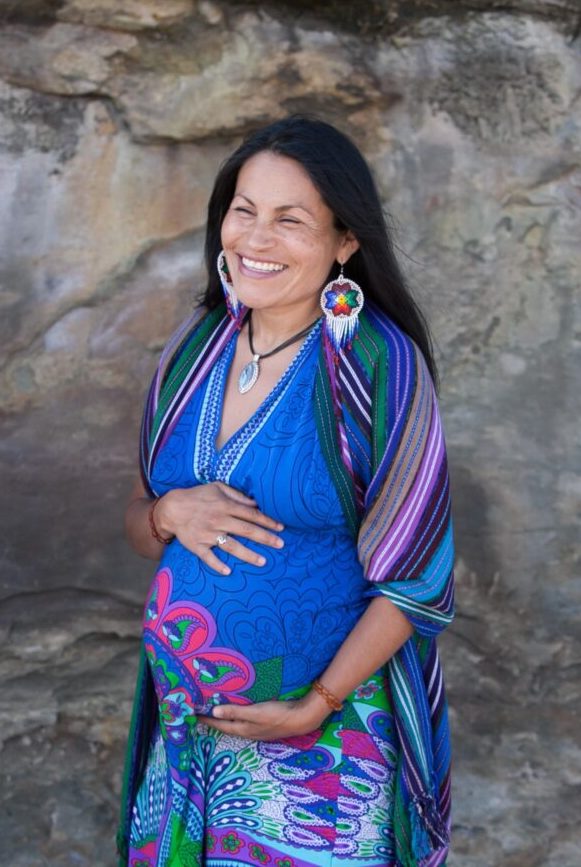
María Ascención Ramos Bracamontes (Merrill ’02, language studies and Latino American and Latino studies) is a certified midwife, community activist, and founder of mutual aid organization Campesina Womb Justice. Photo taken in 2020.
María Ascención Ramos Bracamontes (Merrill ’02, language studies and Latino American and Latino studies) is a community activist and advocate who has spent her career giving back to indigenous and BIPOC communities. She is a certified nurse midwife at Watsonville Community Hospital and Salud Para La Gente, an advocate for the preservation of the Beach Flats community garden, where she hosts healing circles, and is the founder of mutual aid organization Campesina Womb Justice. Primarily serving campesinas, indigenous farmworker women, across South County, Bracamontes has dedicated herself to ensuring they receive the dignity, resources, and culturally informed care they deserve.
It was at UC Santa Cruz where she first found confidence in her voice, discovering a passion for writing and storytelling that would later become central to how she connects with and uplifts the women she serves. She attended nursing midwifery school at UC San Francisco.
Bracamontes started Campesina Womb Justice with a 2020 stimulus check; instead of keeping the check for her and her family, she chose to dedicate that money to helping those that needed it most—farmworkers unable to stay home during the COVID-19 pandemic. The mutual aid group delivered personal protective equipment (PPE), pads, tampons, and other essential items to campesinas.
Bracamontes’s service to her community is documented in The Long Labor, a documentary film by Consuelo Alba and Brenda Avila-Hanna that depicts Bracamontes’s work in South County. The documentary received multiple festival circuit selections including the Mill Valley Film Festival, San Francisco Latino Film Festival, the Watsonville Film Festival, and was recently screened at Cabrillo College.
In 2023, Bracamontes was awarded the NEXTies Health & Wellness Leader of the Year.
“I give back to my community because I wouldn’t be alive without the kinds of people who realize injustices and show up for people in their communities,” Bracamontes said.


Bracamontes immigrated to the U.S. when she was five years old, landing in Santa Cruz’s Beach Flats community. Just two years later, her mom died during childbirth and Bracamontes was ultimately left to care for herself and her siblings.
For much of her childhood, life was about survival. As she got older, she began writing to document her grief. Bracamontes wanted to start anew, making changes that would strip her away from her old life and began spending more time on her academics.
It wasn’t until her high school math tutor brought up applying to college that Bracamontes considered it. Determined to change the trajectory of her life, she applied to UC Santa Cruz and a handful of other schools. With the help of her Coffeetopia co-worker, who was a UCSC student at the time, she turned in her application in the knick of time.
Bracamontes got into all the schools she applied to.
“No one really finished high school in my community, so it was uncomfortable to get into college,” Bracamontes said. “But I was very lucky that I had a few teachers who showed me that I had something to offer. And I also so desperately wanted a different life for my family, so I decided to go for it.“

UC Santa Cruz was the clear choice for Bracamontes who wanted to stay close to care for her siblings. She double majored in Latino American and Latino studies and language studies with a concentration in French. Along with her coursework and juggling three jobs, Bracamontes also danced with Grupo Folklórico Los Mejicas de UCSC to find community.
One of Bracamontes’s favorite classes was poetry. She felt too intimidated to approach professors, but quickly realized that they loved her writing and work. Her love for writing grew so much that she applied to an essay competition which introduced her to many Latina authors. Her essay won.
“Writing made me feel heard. I always felt so invisible in society, as an undocumented brown person and not having parents,” Bracamontes said. “The act of writing is, one, healing. But it also helped me believe in myself and gave me confidence that I can do college.”
In her third year, Bracamontes studied abroad in France and in her fourth year, she met a practicing midwife. The midwife offered Bracamontes a spot in her midwifery class on scholarship and for the entire year, Bracamontes spent her Friday nights training. After graduating from UC Santa Cruz, she decided to pursue social work for adolescents dealing with addiction.
For a while the work was fulfilling, but eventually it wasn’t, so she quit and traveled Mexico with her young daughter, a trip that changed her path again when a local doctor cared for her sick daughter one night.
“He took care of my daughter, and I thought, ‘I want to learn how to take care of people when they’re not feeling well’,” Bracamontes said. “I just loved how accessible he was, so when I came back to the U.S., I started my nursing prerequisites.”
Bracamontes wanted to be a friendly face in the healthcare industry and Campesina Womb Justice was the solution to the problems that Bracamontes witnessed. Working with campesinas who come from Mixteca backgrounds and teaching them midwifery has been one of the most rewarding parts of Bracamontes life.
“I feel very connected to Indigenous people and farm workers and indigenous ways of living. It’s about how to have a lot of humility and respect for all human life and not put yourself above others,” Bracamontes said. “Those are the values that we all need.”