Arts & Culture
Shining a light on Bleak House: 46th annual Dickens Universe embraces Charles Dickens’s dark masterpiece
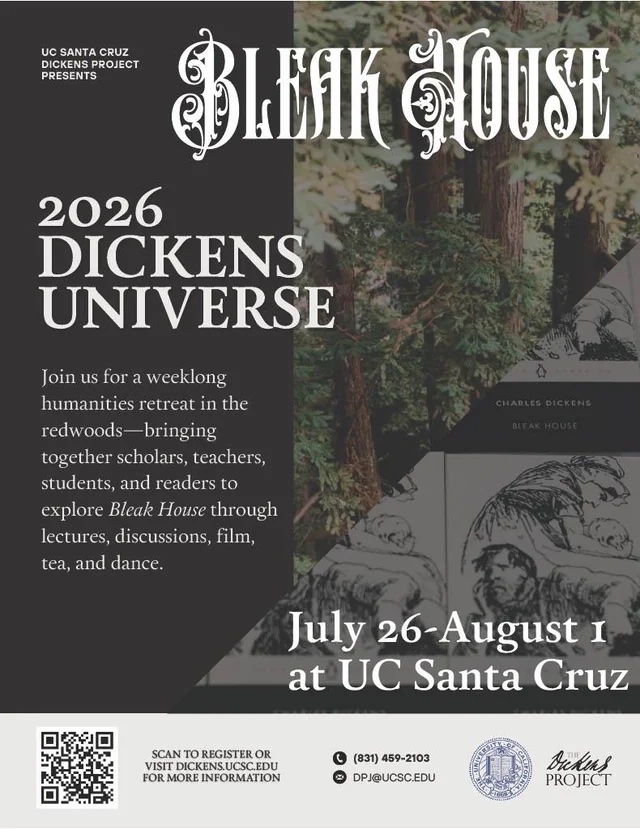
Bleak House, a 377,000-word page turner about family intrigue, wicked lawyers, and grinding legal bureaucracy, will be the focus of the 46th annual Dickens Universe this summer.
Bleak House, a 377,000-word page turner about family intrigue, wicked lawyers, and grinding legal bureaucracy, will be the focus of the 46th annual Dickens Universe this summer.
Published as a 20-episode monthly serial in 1852–53 and in book form in 1853, Bleak House is Charles Dickens’s ninth novel and widely regarded as one of his masterpieces.
This densely plotted and thick book – the Penguin Classics edition is 1,088 pages – follows the lives of families ensnared in the decades-long Jarndyce and Jarndyce legal case.
The beloved annual Dickens Universe goes far beyond a traditional literary scholarly conference.
It also functions as a festival, a book club, and, in the words of New Yorker writer Jill Lepore, a “Dickens camp.” This year’s edition runs from Sunday, July 26, to Saturday, August 1 at Cowell and Stevenson Colleges.
The Universe offers a week of total immersion in the world of Victorian fiction with friendly, like-minded colleagues in a beautiful setting. Part of the Dickens Universe tradition is to alternate between an early novel by Dickens and a later one.
“Since his later novels are generally more famous, or at least better known, this plan allows us to showcase some of his less familiar works, while continuing to bring back the old favorites from later in his long career,” said Emeritus Professor of Literature John Jordan, co-director of the Dickens Project, an international consortium headquartered at UC Santa Cruz, with Associate Professor of Literature Renée Fox.
To some extent, this principle of alternating early and late novels was a factor in guiding the selection of Bleak House for the 2026 Universe.
“It also helps us to boost attendance when we feature one of his more celebrated titles,” Jordan said.
Last year, the featured work was The Old Curiosity Shop, an early novel that many readers – most notably Oscar Wilde – dismissed as overly sentimental and one of their “least favorite” among Dickens’s works, Jordan noted.
“While last year’s conference did a superb job of opening up new and interesting ways of thinking about a book that has been too easily dismissed, the return to a late and more mature novel like Bleak House offers a different kind of challenge,” Jordan said.
Bleak House has been discussed and analyzed by so many Dickens scholars that it raises an intriguing question: will there be anything new to say about this work of literature, one that is often cited as among the greatest novels of the Victorian period?
“We think the answer is yes, and we have enlisted a group of speakers who will approach it from fresh angles,” Jordan said.
Carleton University English Professor Barbara Leckie will take an eco-critical approach to Bleak House, focusing on issues of climate change and environmental degradation as represented by Dickens in this novel.
City University of New York English Professor Talia Schaffer will examine communities of care in the novel, with special attention to social ethics and issues of disability and public health in Bleak House.
University of Southern California English Professor Hilary Schor will give a talk focusing on the often overlooked or under-appreciated figure of the clerk in Dickens’s novels, looking especially at the minor character of Guppy in Bleak House.
One of the reasons that Dickens continues to appeal both to literary scholars as well as to ordinary readers is that his novels always seem relevant to issues and concerns of the present moment. “This is especially true of Bleak House,” Jordan said.
Among the topics with which it deals are many problems familiar to readers of today: a legal system detached from questions of justice, a government divided between competing factions and seemingly unconcerned with the needs of the people, and the persistent threat of class violence and even revolution.
Jordan also listed “urban pollution and widespread environmental degradation; homelessness, poverty, and food insecurity; public health and the uncontrolled spread of disease; child abuse, parental neglect, and the breakdown of the family; and the limitations of private philanthropy” as other perennial concerns that are dramatized in Bleak House.
Yet despite the bleakness of its outlook on these social problems, Bleak House, like all of Dickens’s novels, is full of comic passages and scenes featuring silly characters with ridiculous-sounding names–Jellyby, Turveydrop, Skimpole, Pardiggle, and Guppy.
It is also one of the first detective novels in literature, featuring the incomparable Inspector Bucket, an investigator endowed with what seem at times almost like supernatural powers, Jordan said.
Jordan also described the novel as a “a magnificent ghost story,” haunted by
ghosts from the past, present, and future.
The novel is experimental in form, its narration split between two narrators: one a young woman named Esther, who tells the story of her earlier life, the other an impersonal, “omniscient” voice that “speaks” always in the present tense.
“As if all this were not enough, Bleak House is also a profoundly psychological novel, full of insights into the working of the unconscious mind that anticipate Freud,” Jordan said.
Whether you’re a long-time reader of Dickens or a relative newcomer to his work, the Dickens Universe is a place where you’ll find yourself at home among friendly people who like to read good books. For more information, go to: dickens.ucsc.edu.